

“Please Save the Beaver for Canada”: Legislating a National Symbol, 1975
Colin M. Coates
In 1975, after a concerted public campaign, the beaver became a national symbol of Canadian sovereignty. In the space of a few weeks, following reports that New York might claim the semiaquatic rodent as its state symbol, over 13,000 letters, postcards and signatures on petitions poured in to support a young Progressive Conservative MP’s bid to save the beaver for Canada. Passing the House of Commons through all-party support, it became law on March 24, 1975. Official recognition has been accorded to a limited number of symbols in Canada; among others, the national flag and anthem (by definition) and the country’s summer and winter sports (lacrosse and hockey). While the party in power proposed some of these laws, such as the national flag, others resulted from private members’ bills – rarely a source of successful legislation in the Canadian parliamentary system. In this article, the author explores how this legislative campaign reveals features of Canadian nationalism in the volatile 1970s, as well as some of the vernacular understandings of the potential scope of government action.
Colin M. Coates is a professor of Canadian studies and history at York University.
1. The American attack on the beaver
The event that precipitated the adoption of the beaver1 as an official Canadian symbol occurred in New York state. In 1974, the New York State Department of Environmental Conservation recommended that the legislature adopt the beaver as the official state mammal, alongside the brook trout as the state fish. In promoting this course of action, H. Wayne Trimm, the art director of The Conservationist, the official publication of the department, referred to the animal’s historical role in encouraging European settlement. It had been recognized in its depiction on the first seal of the State of New York and in the Dutch name for state capital Albany: Beverwyck. Moreover, it embodied attractive human traits as “an industrious animal, which is not too bad a symbol these days,” Trimm stated. The publication also referred to the monogamous nature of the animal. If adopted, the beaver and the brook trout would join other state symbols: the sugar maple, the wild rose, the bluebird, and the garnet. Reported on page 41 of the Sunday edition of the New York Times, this was not front page news.2
Canadians did not react to this initial proposal, but when news spread that state senator Bernard Smith, the Chairman of the New York Senate Committee on Conservation and Recreation, planned to introduce the appropriate legislation, fulfilling the department’s recommendation, Canadians began to notice and engage with the issue.3 Hope Ryden, an ethologist (animal behaviour scientist), published a detailed natural history of the beaver, lending her support to the state bill designating it as the official state mammal. Recognizing that the beaver had almost been extirpated from the state, she explored the history of the fur trade in the region and conveyed the animal’s habits and abilities. She profiled the Grey Owl-like character, Dorothy Richards, who raised beavers on her property in upstate New York. She concluded her piece by detailing the laudable characteristics of the animal: “Besides being clean, good-natured, intelligent, sociable, cooperative, adaptable and hard-working, the beaver is a jack-of-all-trades. It is a lumberjack, hydraulic engineer, carpenter, canal builder, mason, hair dresser and, no doubt, a dozen other things I haven’t thought of. What other animal is so qualified to personify such a diverse people as we are?”4 Canadians would later point to some of these same features to justify their choice of the animal as a national symbol. Within days of the publication of Ryden’s article, and spurred on by journalists, Canadian politicians began to stake their own claims on the beaver.
2. The Canadian response
Toronto Sun journalist Mark Bonokoski, one of the first members of the media to notice the American effort, contacted the office of former Prime Minister John Diefenbaker for comment. Diefenbaker’s executive assistant, Keith Martin, tur. ned over the story to his friend, 22-year-old Progressive Conservative MP Sean O’Sullivan (Hamilton-Wentworth). Martin encouraged O’Sullivan to raise it in Question Period in the House of Commons. “It will go everywhere!!”, Martin assured the young MP.5 He was correct.
On the second last sitting day before the 1974 Christmas break, Question Period was dominated by issues related to crime, transportation policy, and racist slurs against Progressive Conservative MP Lincoln Alexander (Hamilton West).6 With Secretary of State Hugh Faulkner absent from the House, O’Sullivan opted to write immediately to the minister, urging him to operate through diplomatic channels and dissuade the New York state legislators from proceeding. He also recommended that Faulkner consider according “some official status” for the beaver “as one of the symbols of Canada’s rich heritage.”7 O’Sullivan also spoke to Faulkner’s parliamentary secretary, Gustave Blouin (Manicouagan), who expressed surprise that Parliament had not already recognized the beaver as a “national emblem.”8 Indeed, the files of the Secretary of State contain a series of letters dating back to the 1930s that posed questions about the official status of the beaver as a Canadian symbol.9
Faulkner did not respond formally to O’Sullivan’s letter until February 5, 1975. His reply was cautious, but logical: “Even if the beaver were to be registered officially as a national symbol of Canada under section 9 of the Trade Marks Act, there is no legal action that could be taken against the State of New York to prevent that State from using it as its emblem.”10 The wording was taken directly from an earlier memorandum submitted by Jean Boucher in his office. That memorandum accompanied a draft letter to the Secretary of State for External Affairs providing terms that could be used to present a mild protest to the United States and government of New York. Faulkner never sent this letter to his colleague.11 The Secretary of State clearly had little interest in this issue. Writing to elementary school students some weeks later, Faulkner claimed, “Some Canadians are flattered that the State of New York is planning to honour the Beaver as Canadians have done in the past and are continuing to do today.”12 This response was not reflective of any of the correspondence that his office had received.
The issue began to gather momentum and O’Sullivan realized he had an opportunity to enhance his political profile. As his memoir later recalled, in terms reminiscent of the general rhetoric, O’Sullivan saw the potential in this issue: “the beaver was about to be kidnapped by Americans.”13
Having sowed the seeds for his own story, Bonokoski published an article on December 20, 1974 warning of the upcoming New York legislation. In one of the many wordplays that typified press coverage, Bonokoski wrote that “New York is busy as a beaver stealing our dam emblem.” Within a few days, CBC Radio was on the case. As It Happens launched a public petition, commissioned a French horn quartet to play an ode to the beaver, and brought a live beaver into the studio, which proceeded to pee on host Alan Maitland.14
3. Public involvement
Despite the dire warnings about American cultural imperialism, the tone of the debate was often jocular. Public reaction was swift and voluminous. Thousands of letters and signatures on petitions poured in. Many came to the CBC, but O’Sullivan and other MPs received their share, and a few hundred ended up in the files of the Secretary of State. Keeping in mind the fact that Faulkner had little personal interest in the issue, his staff responded carefully, if formulaically, to the interventions that had provided postal addresses.
With the absence of postage fees for correspondence with Members of Parliament, it’s understandable that many Canadians choose to share political opinions with elected representatives via mail. However, it is difficult to compare the scale of public engagement in this case with others.15 CBC producer Mark Starowizc recalled “big canvas mailbags of petitions,”16 suggesting the public support to make the beaver a national symbol was notable, strong, and perhaps overwhelming.
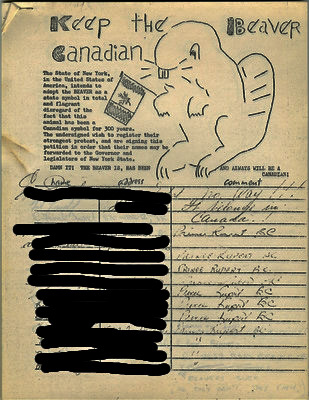
Support came in many shapes: signatures on hastily designed petitions, a few words on postcards, longer letters with reasoned arguments, sketches of beavers, and poems. Individuals drew up, mimeographed, and circulated petitions. “Keep the Beaver Canadian” petitions came from, among other places, 100 Mile House, BC; Edmonton; Acton, ON; Saint John, NB; Ottawa; and the first floor of North Eaton House, Acadia University.17 One petition deferentially admitted that not all the signatories were of voting age, but the sender still hoped that the submission would be considered, given the urgency of the matter: “it can’t wait till we can vote. And we feel it concerns us since we feel the loss…”18 The majority of the letters were hand written, and the petitions were fairly amateurish, demonstrating the groundswell of grassroots support for the proposal among people who may not have otherwise routinely engaged in political debate.
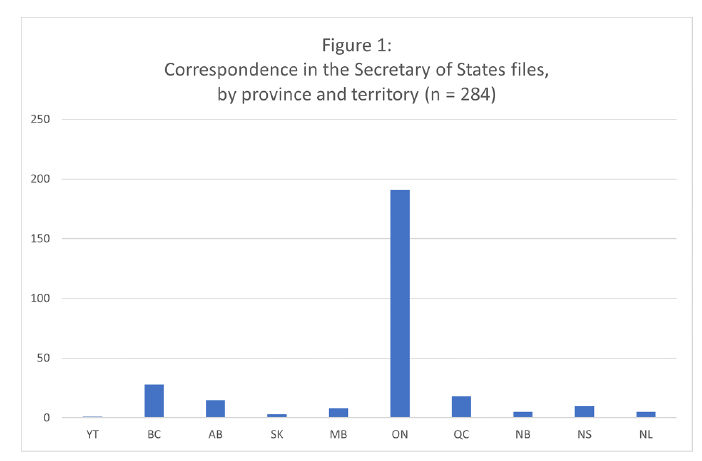
Of the 284 letters and petitions to which it is possible to ascribe a geographical location, a strong majority came from Ontario (Figure 1). But interventions arrived from all provinces, except for Prince Edward Island, with one from Yukon. The national scope across Anglophone Canada of As It Happens likely accounts for the coast-to-coast interest. Numerous writers referred specifically to the CBC program.
Some teachers also clearly saw an opportunity to involve their students in civic debate and the political process. Whole classes at Centre Dufferin District High School in Shelburne, ON; Fisher Park High School in Ottawa; W.D. Lowe Secondary in Windsor, ON; and Curling Elementary School in Curling, NL sent in their petitions and representations, likely the first time the young citizens had ever written to the Canadian Parliament. One group from the St. John’s School in Kitchener, conveyed their views, undoubtedly informed by a teaching unit on the beaver. One young student justified her support by noting that the beaver “provides homes and breeding places for wildlife, their dams help control floods and they also keep soil from washing away.”19
While most of her classmates took up the cause, some dissidents expressed their preference for other emblematic animals. One classmate did not believe that the beaver was beautiful, nor was it swift. He recommended the lynx, and he was concerned that it would upset Americans if Canadians insisted on the beaver.20Adults could share the concern about the choice of the beaver. Dave Bayus of Oshawa wrote to his local MP, Ed Broadbent: “the beaver is a relative of the rat family, a rodent, does very little good other than supply pelts for the trappers. Actually its ugly.”21 Kenneth A. Benson of Toronto argued that New York State had a reasonable historic claim on the beaver.22 But such contrary voices were very much the minority.
The letters to MPs were almost exclusively written in English, even when the author was a Francophone. The 1970s were a tense time in relations between Anglophones and Francophones, and particularly among Francophones who expressed different views on the use of their second language. Somebody, likely in Faulkner’s office (it seems unlikely that this could have occurred at the post office), scribbled EN FRANÇAIS ÉCOEURANT (“In French, jerk!”) on the short English-language representations clearly written by Francophones, in this case the four postcards sent in by different members of the Gautier family from Hull (Gatineau). A petition entitled “Please affix these names to the Private Members Bill Save the Beaver” came from the “Elèves de 5e année” of an unknown school. The petition was in English, but most of the 129 signatures indicated French-Canadian names.23 One of the few French-language interventions came from Marc Morin in Rockwood, ON, who supported O’Sullivan’s eventual Save the Beaver Private Members Bill because “Le castor [est] l’une de nos dernières ressources naturelles qui soient encore de propriété canadienne…”24 The standard reply, signed by staff member Pierre Forget, was written in English.
The typical intervention simply asserted support for the Beaver Bill. But some writers provided more detailed reasons. Caught up in the media campaign, they expressed the view that the timing was urgent. If Canada declared that the beaver was a national symbol, many claimed, this would stop the Americans from doing the same. Underlying this logic was likely a belief in the legal authority of brands. If the Canadian parliament adopted the beaver as a national symbol, the letters implied, then no other jurisdiction could do so.25 Conversely, if the Americans passed their law first, then the Canadians would surrender their ability to consider the beaver a national symbol. This was clearly not the case, as the minister had recognized, but the rhetoric of the time encouraged such a perspective. A few correspondents pointed to specific ways in which the beaver already operated as on a symbolic level. Weeks before the introduction of O’Sullivan’s bill, one early letter-writer, Paulette Rousseau of Sault Ste Marie thought the five-cent piece was at risk: “We have invested probably millions of dollars in the minting of nickels with the beaver on it. Please save our beaver! Keep it Canadian.”26 In fact, some Canadians expressed concerns about copyright issues after the bill was passed. The city clerk for Saint John, NB, wrote to a Progressive Conservative MP representing a nearby riding to confirm “the City of Saint John’s right to continue to use the Beaver as part of its crest.”27
Some writers emphasized the intrinsic qualities of the beaver, at least as they are often expressed in an anthropomorphized way. Steve Rodney of Ottawa wrote that the beaver “represents industriousness, skill and hard work. If we should loose (sic) the beaver we shall loose our oldest and most valued symbol of our Canadian culture.”28 Chuck Meagher of Medicine Hat, AB, appealed to the historical importance of the beaver: “It represents the competitive ethic of the fur trade that opened up this nation.”29 But, surprisingly, relatively few writers referred to the animal’s characteristics or linked it to a specific historical role, though undoubtedly many of them took these attributes for granted.
Rather the key argument was simply that the beaver was already a Canadian symbol, and therefore it should remain that into the future. Although this is essentially a circular argument, it was the most compelling reason for supporting the bill. Mary Edith Garniss of Wingham, ON, confirmed this view: “The beaver has always been unofficially the Canadian emblem, since it is a part of our natural wildlife. Therefore, it should be adopted formally by the Canadian federal government before it is overtaken by our hungry neighbour. There is enough American domination in Canada without allowing our symbols to be stolen as well.”30 For Ken Valline of North Vancouver, “The beaver to Canada is like the Crown Jewels to England.”31
For some correspondents, expressing views on the beaver question allowed them to add their own statements on the state of the country and their concerns about historical change and contemporary issues. For example, Phyllis Crampton of Hamilton complained about the lack of nationalism among Canadian youth, presumably aware that she was writing to a very young MP: “Why aren’t the young people in schools to-day taught to respect & be proud of Canada as a whole, They look down on it, & take all they can get for nothing…”32 In addition to pledging her “full support” for the bill, Nora Gleeson of Chalk River, ON, added that, “I am also in favour of bringing back the Death Penalty for Murderers.”33
But the key arguments related to attitudes to the United States, and to the extent that the letters reveal the writers’ ideological stances, people from both the left and right agreed on their attitudes to Canada’s southern neighbour. Falling shortly after the end of the Vietnam War and the resignation of Richard Nixon, and reflecting concerns about American involvement in Canada, many writers – as O’Sullivan expressed it – thought that the Americans were stealing the Canadian beaver. It is unlikely that if Sweden, for instance, had expressed the desire to designate the beaver its national animal, the result would have been the same. But New York State occupied a much different place in the Canadian consciousness, and many writers wrote in negative terms about the United States. In that sense, the beaver issue became a metaphor for US imperialism in Canada, and the correspondents drew on imagery of crime and economic domination. Sharon Metcalfe of Almonte, ON, wrote that “The Yankees are trying to steal our symbole (sic)…”34 M. Nadeau thought that if the Canadian government acted quickly, the Americans would not be able to adopt the same symbol: “The Americans can always find a substitute. (We suggest a rat.)” The letter was signed, “some patriotic Canadians.”35 Charles Hackland complained about American rapacity: “The Americans have taken a great deal out of Canada, more perhaps than they are entitled to. They will continue to do this as long as our government does nothing.”36 From Mississauga came a similar complaint: “Don’t let them Yanks steal everything from us. They already have our land, businesses, oil, water etc etc PLEASE don’t let them take our BEAVER.”37 The fact that an American state was attempting to adopt the symbol was a key element in provoking a deeply felt Canadian reaction.
4. Private members’ bills
In theory, the government could have taken on the task of introducing legislation to confirm the beaver as an official symbol of the country. But Faulkner realized that legislation would not stop New York from declaring its own intentions, and his staff did not initially think that the issue was garnering much attention.38 O’Sullivan effectively made the beaver issue his own.
In late January 1975, O’Sullivan had his chance to introduce his private member’s bill. But the Hamilton MP was not the first to think of presenting a private member’s bill to recognize the beaver. His fellow Progressive Conservative MP Stan Darling (Parry Sound – Muskoka) had presented Bill C-331 on October 15, 1974, “to provide for a National Emblem for Canada.”39 The bill declared that “the official emblem for the Dominion of Canada shall be the beaver.”40 As was often the case with private members’ bills at that time, C-331 passed first reading, but then died on the order paper. Darling recalled that he withdrew his bill to allow O’Sullivan to present his version, but O’Sullivan does not mention him in his memoirs, nor did Darling second O’Sullivan’s bill when it was presented in parliament. Rather, that task fell to another backbencher, Joe Clark (Rocky Mountain).
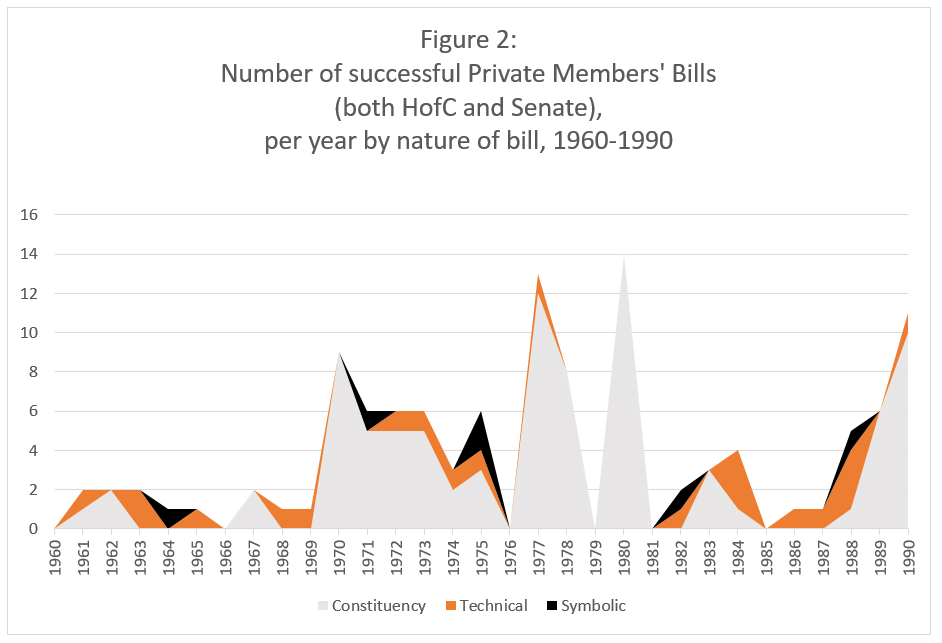
During the 1970s, the type of private members’ bills that passed into legislation usually involved changing the name of a constituency (for instance, from “Bruce” to “Bruce-Grey”), a clearly local issue, but one that needed the consent of parliament. Occasional bills of a technical nature also acquired the support to ensure passage. For instance, in 1975, John Reid (Kenora-Rainy River) shepherded through the House a bill amending the Fort-Falls Bridge Authority Act by altering the date of the bridge’s construction.41 Acts with a symbolic intent, such as the beaver bill, were rare during the 1970s. Later examples include the analogous bill which proclaimed Canada’s official winter and summer sports, hockey and lacrosse in 1994. Previous attempts to make hockey Canada’s official sport had failed when fans of different sports objected. But a somewhat unlikely compromise was reached in 1994 between the NDP sponsor Nelson Riis (Kamloops), the Liberal government, and opposition Bloc Québécois and Reform MPs. A more recent example of such a bill is the passage in 2021 of an Act establishing “Kindness Week.”42
O’Sullivan was well aware that private members’ bills had little chance of passing. If their sponsor is successful in getting a bill onto the order paper, he or she still had to navigate the opinions of all other members of the house. One contrary voice, or one lengthy speech that used up the limited time allotted for debate, scuttled the chances of passage. O’Sullivan had prepared the ground carefully, informing the house leaders of the NDP and Progressive Conservatives of the intentions of his bill. The Créditistes also agreed with the bill. The matter was urgent, he informed his colleagues: “Should this Bill be enacted in Parliament I am then hopeful that the New York State Legislature will find a more suitable state symbol than the Beaver…” He also ensured that he would have the support of the sole independent MP.43
In legislatures that follow the Westminster tradition, backbench MPs tend to have little influence on legislative priorities, and private members’ bills normally die on the order paper. Nonetheless, the 1960s were considered the “golden age” for such initiatives in Westminster itself; private members’ bills were responsible for the Abortion Act, 1967 and the decriminalization of male homosexual acts. Since that time, party discipline and government control of legislative agendas, and some MPs who philosophically favoured reducing state intervention, have rendered passage of private members’ bills very unlikely.44 Some rules concerning private members’ bills differ in Canada, but the context is broadly similar. Private members’ bills in Canada cannot raise or spend money; but such bills may still have an “expressive” function, allowing individual MPs to present their views and attempt to influence public opinion. Still, few private members’ bills that succeed have any “saliency.”45 The strong public support for O’Sullivan’s bill confirmed the performative, but not the legislative, import of the legislation.
5. Debate and passage of the bill
On January 24, 1975, O’Sullivan presented the bill in first reading “to protect the beaver as a popular symbol reserved to Canadians by declaring the beaver a national symbol.”46 By the time the bill reached the debate stage at second reading, O’Sullivan had acquired cross-party support for the measure. His justifications were slightly different by this point. He proposed Bill C-373 “to provide for the recognition of the Beaver (Castor canadensis) as a symbol of the sovereignty of the Dominion of Canada.” This designation technically limited its impact as a national symbol, providing merely that “when the beaver is used by the Queen in Parliament, it can be used as a symbol of the country.”47 In other words, it was the government’s use of the symbol that would be protected, not the vernacular recognition of the beaver as representing the country.
Nonetheless, this was an attempt to “correct an oversight of history…,” because it was easy to “find that the strong, tireless and industrious beaver has always been symbolic of our northern homeland.”48 O’Sullivan cited the many ways the beaver had been used as a symbolic figure: an Indigenous clan sign, a figure carved on totem poles, a symbol on the arms of the Hudson’s Bay Company, and on the heraldry for Sir William Alexander’s short-lived Scottish colony of Nova Scotia in 1692. When O’Sullivan stated that the beaver appeared on the first Canadian stamp, another MP interjected, “Before the Queen?” Yes, the young MP replied, “Before the Queen.” Switching to French, O’Sullivan added that coins, the arms of the City of Montréal, and 14 Canadian regiments all boasted the animal. Trying to head off any opposition, and maybe not wishing to stir up bad feelings from the previous decade’s flag debates, he commented that the beaver and the maple leaf went together. It was true that Oregon, “The Beaver State,” had already adopted the animal (though it uses the Latin name, castor americanus), and its flag dating back to 1925 has the beaver on its reverse (the only two-sided state flag) and of course New York was debating the same issue. But the Canadian claim was stronger, and of broader appeal: it was “a symbol of national significance, well-founded in history and honoured by generations.” Finally, O’Sullivan argued that despite the economic difficulties facing the country, it was still possible to discuss an issue of national identity such as this.
Undoubtedly mindful of the limited time allotted to debate a private member’s bill, only two others spoke on the issue, both of them from the government side. Ian Watson (Laprairie) referred to the use of the beaver by commercial houses in Montréal, and he raised concerns about how the adoption of the bill could raise implications for Canadian heraldry. For his part, Gustave Blouin supported the Beaver Bill with a few illogical references to the ultraconservative Castor political faction of the late nineteenth century. These anecdotes illustrated, rather weakly it may be pointed out, that “the beaver as an emblem has always been and still is related to our history.” Blouin concluded by recounting that some of his Indigenous constituents had pointed out a carving of a beaver on the top of the door to Parliament. With the two lacklustre speeches in support, the bill was referred to the Standing Committee on Justice and Legal Affairs. Here the discussion largely focused on semantic issues. Watson, though not a member of the committee, repeated his concerns about potential heraldry problems, but the members brushed those points aside. In fact, his Liberal colleague, Simma Holt (Vancouver Kingsway), congratulated O’Sullivan for avoiding the language of heraldry and writing the bill in clear prose. The main amendment replaced “Dominion of Canada with “Canada.” Mark MacGuigan (Windsor-Walkerville) emphasized the fact that this was “really quite a modest bill.”49 The bill was returned to the House, and on March 18, it had its third reading, passing without a formal vote.50
The bill received a bit more attention in the Senate. Senator Muriel McQueen Fergusson spoke from the same notes that O’Sullivan had used in the House of Commons; but he had supplied her with more ammunition. Fergusson quoted from the groundswell of letters written in support. For example, Mrs. Constance McDermid of St. Catharines wrote, “Please add my name to your list of supporters in regard to our beaver as an emblem. Why don’t we use the emblem more? It stands for industry and faith. The little creatures build well. Somehow to me beavers mean Canada.”51
Two senators raised questions about the bill that required some research. Senator Jacques Flynn expressed concern that the bill might make it more difficult to use the beaver as a commercial symbol. Senator Josie Quart, also a fan of As It Happens, referred to a problem raised in another segment of that programme which suggested that a National Film Board documentary filmmaker working on a story about Grey Owl had to go to Utah to find beavers for the shoot. The next day, using replies drafted by O’Sullivan, Senator Fergusson closed the debate, reassuring Flynn that no infringement of commercial use was intended. She confirmed Quart’s understanding of the recourse to beaver in Utah but explained that was because there was a beaver farm in that state, and it was able to supply animals less expensively than a trapper could. The bill passed in the Senate without division, and it received Royal Assent, alongside An Act to amend the Prairie Grain Advance Payment Act on March 24, 1975.52 From that moment, the beaver became an official, state-sanctioned symbol of Canada.
6. New York’s symbol
Despite the concerted efforts of Canadians, the beaver also went on to become an official symbol of New York State. Senator Smith had spoken with O’Sullivan on the telephone on January 30, 1975, and he repeated in a letter on February 18, 1975 that he could “see no reason why Canada and the State of New York can not share the same animal, who happily lives in our respective geographical areas.”53 The New York Assembly and Senate considered their own legislation at the same time that O’Sullivan’s bill worked its way through the Canadian parliament. They even maintained the official scientific designation of the beaver as “castor canadensis,” although sometimes the phrasing “castor americanus” was used.54 New York State legislators likewise ignored the light-hearted protest from Jason Boe, president of the Oregon State Senate in early May. Writing to the New York Times, Boe claimed to having been “pelted with letters from the citizens of Oregon who are raising their tails in protest. This damning reaction should cause you gnawing doubts as to the sagacity of such fur-fetched legislation.” He concluded by asking “that you keep your hands off our beaver.”55
In July, the Senate bill was returned to the governor of New York for his signature.56 A range of other state symbols have since joined the beaver, including an official fossil (1984), shell (1988), insect (1989), saltwater fish and reptile (2006), as well as an official state fruit (the apple), muffin (the apple muffin), beverage (milk), and bush (the lilac).57 The Canadian government has not proliferated its symbols to the same extent.
For O’Sullivan, another Toronto Sun article published just two days before the third reading of his bill was likely more disturbing than having to share the beaver with two states. Under the headline: “It was only a joke!” Bonokoski admitted his role in the whole affair, and complained that “now we’re stuck with a rodent as a symbol of Canadian nationalism.” He pointed out that Canadians had turned their attention from much more important matters like inflation, taxes, strikes, violence, famine, wars and the price of alcohol to focus on this issue of national identity.58 Still, he had the audacity to ask O’Sullivan for a letter of acknowledgement of his role in the process, planning to submit the file for a newspaper journalism award.59 O’Sullivan took some weeks to send the letter, confirming he had learned about the New York senator’s plan from Bonokoski. But, wounded, O’Sullivan wrote separately to the journalist, assuring him that “I would not take up the time of Parliament on any matter lacking any serious importance.”60 Similarly, he took umbrage to Globe and Mail journalist Geoffrey Stevens’ assessment of the beaver campaign as “a phony issue.” “I can assure you,” O’Sullivan wrote Stevens, “that I do view such an issue as being a serious and legitimate one for consideration by the House.”61 This legislation was one of O’Sullivan’s major parliamentary achievements. Questioning his own future and unhappy with the election of his erstwhile ally, Joe Clark, as party leader in 1976, O’Sullivan resigned from the House the following year and joined the priesthood.
Conclusion
The beaver bill of 1975 reveals some of the limitations of the official recognition of national symbols, and it raises some important questions: Does it matter if a government recognizes a popular symbol? Does that act provide more legitimacy to the symbol? Lacrosse may have become the official summer sport of Canadians in 1994, but it remains a relatively minor sport, not figuring among the top 25 sports by participation in a Statistics Canada survey from 2010.62
Does state recognition lend weight to an icon? The key argument that most members of the public could muster was that the beaver was already a symbol of Canada, and therefore it should be legislated as a symbol of Canada. It was not the “beaver-ness” of the beaver that counted, but rather its “symbol-ness.” This is the banality of nationalism, to borrow an expression from Michael Billig. For the sociologist, the everyday experience of national identity is key to understanding the ideology: “Banal nationalism operates with prosaic, routine words, which take nations for granted, and which, in so doing, enhabit them.”63 In the case of the beaver, it is the five-cent piece, the Roots Canada and Parks Canada logos, among other illustrations, that underline the place of the beaver in the pantheon of Canadian national symbols. We cannot know how Canadians would have reacted if an American state had chosen the caribou, featured on the 25-cent piece since 1937, to be its symbol, or the moose, or for that matter the Canada goose. But perhaps the beaver holds more gravitas for Canadians than the other animals. During the contentious debate over the maple leaf flag in the 1960s, some western Canadian MPs admitted preferring the beaver, because at least the rodent appeared naturally in their part of the country, unlike the maple.64 But by the same token, the natural range of the beaver extends well into the United States.
The debate over the beaver bill allowed Canadians to express some general anti-American attitudes in a playful manner, not likely to offend – or really, for that matter, even to be noticed. These debates make it clear that, in the 1970s, anti-American sentiment, often fairly visceral, was more than an elite-driven rhetorical stance, despite the arguments of historians like J.L. Granatstein.65 A strict reading of the bill does not protect the public use of the beaver as a national symbol, which was the goal of many of the letter-writers, but rather the government’s use. To be fair, the government could not legitimately do much more, even though the rhetoric in the debate hoped that it could.
Although the over 13,000 people66 who took the time to sign petitions or send postcards or letters to their politicians clearly felt otherwise, the beaver’s role as a symbol of Canada did not depend on the government’s authorization. It stemmed from history, from anthropomorphizing a non-human species, and the reassurance stemming from a tradition that the beaver had always been a symbol of the country. The timelessness of the beaver made it an appropriate choice for many Canadian citizens and their legislators to agree on in 1975. They entrusted the exclusivity of an expression of national identity to the legislative process that could not do anything effectively to guarantee it. On some level, Canadian citizens believed that the state could deliver.
Notes
1 I discuss the broader history of the beaver as a Canadian symbol in “The Beaver” in Michael Dawson, Catherine Gidney and Donald Wright, eds., Symbols of Canada (Toronto: Between the Lines, 2018), pp. 8-17. I would like to thank the editors of that book for encouraging me to write on this topic. Philippe Thompson and Sydney Manton provided research assistance.
2 Harold Faber, “Beaver and Brook Trout Urged as State Symbols.” New York Times, 25 August 1974.
3 The timing of the Canadian reaction suggests that it was a December 15, 1974 article in the New York Times that occasioned the concern, although refracted through Newsday (another New York area newspaper). Brock University Archives, Sean O’Sullivan fonds, RG431-1 [hereafter SO fonds], 12.26, Secretary of State – Beaver Bill, 1974-75, Keith Martin to Sean O’Sullivan, 19 December 1971.
4 Hope Ryden, “Let’s hear it for the eager beaver.” New York Times, 15 December 1974, pp. 38-41, 44-45, quotation from p. 44.
5 SO fonds, 12.26, Secretary of State – Beaver Bill, 1974-75, Keith Martin to Sean O’Sullivan, 19 December 1974; Sean O’Sullivan with Rod McQueen, Both My Houses: From Politics to Priesthood (Toronto: Key Porter Books, 1986), pp. 96-99.
6 House of Commons Debates, 30th Parliament, 1st Session, vol. 1, 19 December 1974, pp. 2389-97.
7 SO fonds, 12.26, O’Sullivan to J. Hugh Faulkner, Secretary of State of Canada, 19 December 1974.
8 SO fonds, 12.26, Handwritten notes about O’Sullivan’s conversation with Blouin, 19 December 1974.
9 The staff responses to the queries were fairly standard. This wording from 1935 is typical: “I do not know of any official recognition of the beaver as an emblem of Canada although, I am aware, it is very popularly used.” LAC, Secretary of State, BAN #2002-01398-X, Box 150, File #7974-5 [hereafter Sec. State], Vol. 1, E. H. Coleman, Under Secretary of State, to John W. Regan, Halifax, 28 March 1935.
10 SO fonds, 12.16, Faulker to O’Sullivan, 5 February 1975.
11 Sec. State, Vol. 4, Memorandum to the Minister, 10 January 1975; draft letter to the Secretary of State for External Affairs, no date; notes, dated 30 January 1975, AC (Andrew Cohen) to JB (Jean Boucher).
12 Sec. State, Vol. 6, J. Hugh Faulkner to Grade 5 Class, Curling Elementary School, Curling, NL, 26 February 1975.
13 O’Sullivan, Both My Houses, p. 97.
14 “Ten years of As It Happens,” 17 November 1978, https://www.cbc.ca/player/play/audio/1.3333223; Mary Lou Finlay, The As It Happens Files (Toronto: Alfred A. Knopf, 2008), p. 26; Kevin van Paasen, “Mark Starowicz, the last of CBC’s great documentarians, rolls the credits” Globe and Mail, 31 July 2015.
15 Here are two contrasting examples. In the United States on April 11, 1968, days after the assassination of Martin Luther King Jr, Republican governor of Maryland Spiro Agnew confronted African-American leaders. He claimed they had not denounced clearly enough the wave of violence that had followed. By the end of the month, his office reported having received 7,588 letters and telegrams of support, against only 1,042 which criticized his position. See: Clay Risen, “How the Party of Lincoln Became the Party of Racial Backlash.” New York Times, 31 March 2018; More recently, in a context in which letter-writing has become less common, members of the public sent “hundreds” of letters and emails to federal Justice Minister Jody Wilson-Raybould in reaction to the decision in the Gerald Stanley murder trial. A CBC journalist described these communications as a “flood of correspondence.” See: Kathleen Harris, “‘Do something’: Liberals faced angry backlash over Colten Bushie case”, 11 May 2018, http://www.cbc.ca/news/politics/justice-minister-letters-boushie-1.4655794; Tom Perry, “Justice minister’s tweet on Boushie verdict inspired wave of angry emails, letters,” 26 May 2018, http://www.cbc.ca/news/politics/boushie-trial-minister-tweet-1.4679089 .
16 van Paasen, “Mark Starowicz.”
17 SO fonds, 12.16, “Keep the Beaver Canadian” petition, no date.
18 Sec. State, Vol. 2, David Hayashida, 21 January 1975.
19 SO fonds, 21.26, student from St. Johns School, Kitchener, to Joseph Flynn, MP, 31 January 1975. (I am not including the student’s name in this or the next note, given their young ages when they wrote the letter. The names of adult authors of letters are indicated.)
20 SO fonds, 21.26, student from St Johns School, Kitchener, to Joseph Flynn, MP, 31 January 1975.
21 SO fonds, 21.26, Dave Bayus, Oshawa to Ed Broadbent, 26 January 1975. Likewise, HJ Jolly, Grassie, ON to O’Sullivan, no date (received 21 February 1975.)
22 Sec. State, Vol. 5, Kenneth A. Benson to James H. Faulkner, 26 January 1975.
23 Sec. State, Vol. 2, Petition, 24 January 1975.
24 “The beaver is one of our last remaining natural resources that are still Canadian-owned…”, Sec. State, Vol. 2, Marc Morin, 21 janvier 1975.
25 On the history of brands, see Liz Moor, The Rise of Brands (Oxford: Berg, 2007).
26 Sec. State, Vol. 1, Paulette Rousseau, 7 January 1975.
27 SO fonds, 12.21, Secretary of State, Beaver Bill, 1975, Correspondence. A-22-4, D. H. Garey, Common Clerk, to R. Gordon Fairweather, 21 April 1975.
28 Sec. State, Vol. 1, Steve Rodney, 8 January 1975.
29 SO fonds, 12.26, Chuck Meagher to Sean O’Sullivan, 20 January 1975.
30 Sec. State, Vol. 5, Mary Edith Garniss, Wingham, ON, 6 February 1975.
31 SO fonds, 12.27, Ken Valline, 16 February 1975.
32 SO fonds, 12.26, Phyllis Crampton, Hamilton to O’Sullivan, 22 January 1975.
33 Sec. State, Vol. 2, Nora Gleeson, Chalk River, ON, 20 January 1975.
34 Sec. State, Vol. 1, Sharon Metcalfe, Almonte, ON, 28 December 1974.
35 Sec. State, Vol. 1, M. Nadeau, Iroquois, ON, 27 December 1974.
36 Sec. State, Vol. 1, Charles and Susan Hackland, Ottawa, ON, 27 December 1974.
37 Sec. State, Vol. 2, B. Montgomery, Mississauga, 21 January 1974.
38 Sec. State, Vol. 4, ? to WL, notes, 14 January 1975: “So far we have received 35 letters on the subject.”
39 House of Commons Debates, 30th Parliament, 1st Session, 1974, vol. 1, p. 378. Darling mistook the chronology in his memoirs, dating the debate over the beaver issue to 1977, and interestingly not remembering what New York State had decided. Darling with Beth Slaney, Darling Diaries: Memoirs of a Political Career (Toronto: Dundurn Press, 1995), p. 50.
40 Jim Cameron, The Canadian Beaver Book: Fact, Fiction, and Fantasy (Burnstown, ON: General Store Publishing House, 1991), p. 11.
41 Kelly Blidook argues that Private Members’ Bills, even unsuccessful ones, may be more significant than often thought in that they propose items that influence government policy. This article acknowledges the importance of rule changes introduced in 1985 and later modifications. “Exploring the Role of ‘Legislators’ in Canada: Do Members of Parliament Influence Policy?” Journal of Legislative Studies 16, 1 (March 2010): 32-56. However, a study based on extensive interviews with former MPs suggests that party discipline constrains the Private Members’ Bills that individual MPs present and vote upon. Alison Loat and Michael MacMillan, Tragedy in the Commons: Former Members of Parliament Speak Out About Canada’s Failing Democracy (Toronto: Random House Canada, 2014), p. 215, 231.
42 “Private Members’ Public Bills Passed by Parliament: 1910-Present,” URL: https://lop.parl.ca/sites/ParlInfo/default/en_CA/legislation/privateMembersBills
43 SO fonds, 12.21, Secretary of State, Beaver Bill, 1975. A-22-4, Letters to Stanley Knowles, Walter Baker, Jerry Yanover, John M. Reid, 10 February 1975; Leonard C. Jones to O’Sullivan, 14 February 1975.
44 Alex Brazier and Ruth Fox, “Enhancing the Backbench MP’s Role as a Legislator: The Case for Urgent Reform of Private Members Bills” Parliamentary Affairs 63, 1 (2010): 201-11; Holly Marsh and David Marsh, “Tories in the Killing Fields? The Fate of Private Members’ Bills in the 1997-2001 Parliament” Journal of Legislative Studies, 8, 1 (Spring 2002): 92-112.
45 R.V. Stewart Hyson, “The Role of the backbencher – An analysis of private members’ bills in the Canadian House of Commons” Parliamentary Affairs 27 (March 1974): 262-72.
46 House of Commons Debates, 30th Parliament, 1st Session, 1975, p. 2573,
47 MP Mark MacGuigan, Minutes of Proceedings and Evidence of the Standing Committee on Justice and Legal Affairs, 12 March 1975, pp. 15-34. Copy in SO fonds, 12.27, Secretary of State – Beaver Bill, Part II. Mar.-April 1975.
48 House of Commons Debates, 30th Parliament, 1st Session, 21 Feb. 1975, p. 3463.
49 Minutes of Proceedings and Evidence of the Standing Committee on Justice and Legal Affairs, pp. 15-33 to 15-42, quotation at p. 15-34, Copy in SO fonds, 12.27, Secretary of State – Beaver Bill, Part II. Mar.-April 1975.
50 House of Commons Debates, 30th Parliament, 1st Session,, 18 March 1975, p. 4215.
51 Senate Debates, 30th Parliament, 1st Session 20 March 1975, p. 686.
52 House of Commons Debates, 30th Parliament, 1st Session,, 24 March 1975, p. 4447.
53 SO fonds, 12.26, Bernard C. Smith to Sean O’Sullivan, 18 February 1975.
54 Journal of the Assembly of the State of New York, 198th session, vol. 2, 2 June 1975, p. 2494.
55 Jason Boe, to the Editor, New York Times, 12 May 1975, p. 26.
56 Journal of the Assembly of the State of New York, 198th session, vol. 3, 9 July 1975, p. 4050.
57 New York State, Department of Environmental Conservation, New York State Symbols, n.d., available at https://dec.ny.gov/get-involved/education/kids-go/new-york-state-symbols
58 Mark Bonokoski, “It was only a joke!” Toronto Sun, 16 March 1975.
59 SO fonds, 12.26, Bonokoski to O’Sullivan, 25 March 1975.
60 SO fonds, 12.26, O’Sullivan to “TO WHOM IT MAY CONCERN”, 16 April 1975; O’Sullivan to Bonokoski, 16 April 1975.
61 SO fonds, 12.26, O’Sullivan to Geoffrey Stevens, 21 February 1975.
62 Canadian Heritage, Sport Participation 2010, Research Paper (2012), p. 34.
63 Michael Billig, Banal Nationalism (London: Sage Publications, 1995), p. 93
64 House of Commons Debates, Hugh Horner (Jasper-Edson), 18 August 1964, p. 6930; F.J.W. Fane (Vegreville), 18 August 1964, p. 6990; A.C. Cadieu (Meadow Lake), 20 August 1964, p. 7067; D.R. Gundlock (Lethbridge), 24 August 1964, p. 7192.
65 J. L. Granatstein, Yankee Go Home? Canadians and Anti-Americanism (Toronto: HarperCollins, 1996). Ryan Edwardson captures the general tenor of anti-American sentiment in Canada in his analysis of The Guess Who’s iconic song from 1970, “‘Of War Machines and Ghetto Scenes: English-Canadian Nationalism and The Guess Who’s ‘American Woman’” American Review of Canadian Studies 33, 3 (autumn 2003): 339-56.
66 Sean O’Sullivan provided this number in the House of Commons. House of Commons Debates, 21 February 1975, p. 3463. In his autobiography, he recalled that more than 10,000 letters had been received by the Minister of State’s office, in addition to which CBC petitions had garnered 13,000 signatures. In fact, the Minister of State’s files contain a more modest number of letters and petitions. O’Sullivan with Rod McQueen, Both My Houses, p. 97.