

Redefining Legislative Compliance: Parliamentary Responses to the Supreme Court of Canada
How willing are Canadian legislatures to comply with the highest court in the land? In this article, which sheds new light on the legislative processes of creating Charter-driven policymaking, the authors provide a new operationalization and conceptualization to legislative compliance with the Supreme Court of Canada. Unlike previous studies of the courts, which have tended to focus on Parliament’s ability to deviate from Supreme Court decisions, the authors build on existing literature to propose measuring compliance on a scale, ranging from non-compliance, to partial compliance, and compliance. By incorporating a measure of partial compliance, they account for the degrees of compliance with Court decisions, in which a legislative response may comply with part, but not all, of a Court decision. The authors, who find that legislatures partially comply with the courts at a high rate (44.7 per cent), conclude that the understanding of compliance is more nuanced than previously understood.
Shauna Hughey, Anindita Ponkshe and Andrea Lawlor
Shauna Hughey is a PhD candidate in McMaster University’s Department of Political Science. Anindita Ponkshe is a Juris Doctor candidate at the Cleveland State University. Andrea Lawlor is an Associate Professor in the Department of Political Science and the Public Policy (Digital Society) program at McMaster University.
Introduction
It is a rare occasion in Canadian politics for legislatures to openly disagree with courts. While an unsuccessful outcome in a major court case may generate a brief intervention by the Minister of Justice expressing dissatisfaction with a particular judicial outcome, outright criticism of the process or a refusal to implement the judiciary’s ruling are virtually unthinkable in the Canadian context. This alignment between the institutions or parliament’s adherence to court rulings, which is known as legislative compliance in the academic literature, is a hallmark of the largely harmonious relationship between courts and legislatures across the federation. It reflects not only a legal imperative (i.e. ensuring legislation is compliant with the constitution or operable with other legislation), but also a norm regarding how the branches of government should interoperate to ensure a functioning parliamentary system.
But this relative peace between a government and the judiciary does not mean there is a lack of friction in implementing court rulings that the government believes are orthogonal to its agenda.1 There are, inevitably, occasions wherein legislators would prefer to challenge the court’s interpretation of a law or not implement the required change. The reasons for this are myriad. Most obviously, when a court strikes down legislation (in whole or part) of the governing party, the government has a direct stake in the loss. But even in situations where the offending legislation is the product of a previous government (and governing party), governments are forced to confront the need for legislative change in a busy legislative environment. As such, legislative compliance may appear as the only choice, even when it places considerable resource stresses on the government.
Yet, on certain occasions, we have seen legislatures deviate from courts’ rulings. For example, following Canada v. Bedford (2013), the Canadian Parliament passed legislation which contradicted the Supreme Court in criminalizing the purchase of sex and creating unsafe working conditions for sex workers. Similarly, following R. v. Nur (2015), Parliament reintroduced mandatory minimum sentences which were struck down by the Court. Thus, even if it is rare, we are forced to confront this concept of compliance (the norm) and deviation (the aberration), because deviation is so politically and legally significant.
In this piece, we look at how to operationalize and measure legislative compliance to court decisions in the Canadian context with an eye to understanding how our system of judicial review and constitutional order can sometimes permit legislative deviation without falling into a state of parliamentary crisis. In short, we argue that legislative compliance is and should remain the norm, but that a (rare) case of legislative deviation, while politically significant and potentially upsetting to the inter-branch relationship, may reflect several democratic considerations (for example, public responsiveness) that do not cause a breakdown in the parliamentary system.
Legislative Compliance and Deviation
Legislative compliance and deviation from court decisions are underexplored concepts in the Canadian context, yet they highlight the critical interaction between parliaments and courts in the legislative process. These concepts are essentially two sides of the same coin – one that represents the responsiveness of legislatures to judicial authority. We often think of the traditional cycle of lawmaking as one where legislatures pass laws that are sometimes reviewed by courts for their constitutionality. In cases where there is no finding of a constitutional breach, the legislation stands. However, where courts find unconstitutionality in the legislation, they have a menu of remedial choices, ranging from reading the legislation down to suspending it or striking it down altogether (amongst others). In response, the legislature can amend the legislation to fix the offending portion or repeal it. We consider this to be legislative compliance – what Kapiszewski and Taylor refer to as the “full execution of the action (or complete avoidance of the action) called for (or prohibited) in one or more court rulings.”2
Demonstrating how elected leaders comply with judicial rulings helps us understand judicial behaviour and, ultimately, the foundation of the rule of law. Governments that comply with court decisions are often thought to be following the required code of conduct in the separation of powers. Paulson defines compliance as the “acceptance of the judgement as final,”3 while operationalizing it as a binary concept (complying or not). Yet, Kapiszweski and Taylor observe that most cases of compliance do not necessarily meet the bar of “full” compliance (or deviation), but may instead fall somewhere between, introducing variation into the concept.
By conceptualizing compliance as a continuous variable, rather than a binary, Kapiszweski and Taylor argue that governments are able to partially comply with the courts. These are cases in which the legislature adopts parts of a judicial decision.4 There is, however, a theoretical challenge in determining what constitutes partial compliance. For example, a delay in implementing a decision could be representative of an unwillingness to comply with a judicial ruling, even if the outcome eventually complies with the Court.5 In placing partial compliance on this continuous scale, we can introduce a degree of nuance in measurement.6
Across nations with independent judiciaries, we see compliance levels varying with the “democraticness” of the nation and levels of government accountability.7 Yıldırım et al. observe non-compliance with the European Court of Human Rights (ECtHR) and show that countries with more adherence to the rule of law and higher human rights scores, alongside strong judicial independence, are more likely to address and include remedies granted by the Commission.8 Furthermore, they note that countries with high levels of equality, protection of individual liberties, social class equality, and access to justice are more likely to comply with ECtHR decisions. In contrast, those with lower levels are more likely to deviate from court decisions and implement laws that are non-compliant even in the face of explicit statements from courts on the matter.9
Public opinion also drives compliance to some degree. This can be a product of the public’s support of the political party who finds themselves offside the court’s ruling, or in agreement with the court’s take on the issue itself. Driscoll et al. find that citizens’ tolerance for deviation depends on their political support for the incumbent government.10 In authoritarian countries, citizens may consider it a norm to see government interference in judicial affairs, enhancing their tolerance towards legislative non-compliance. Some legislators may see the lack of compliance as a regular practice, and their views are largely unaffected by parliamentary deviation. Conversely, political support of courts or perceptions of judicial legitimacy may influence the likelihood of compliance. For example, Carlin et al. find that in Colombia, citizens consider deviation unacceptable.11 Regardless of the vagueness in cases and/or the educational backgrounds of citizens, citizens find it difficult to excuse legislatures’ non-compliance from judicial rulings and do not see deviation as a norm.
Internationally, support for the institution and individual decisions has been shown to impact the willingness of public authorities to comply with a decision.12 In states where the high court maintains a high degree of procedural fairness and transparency, citizens can pressure the legislature to comply as they have a higher degree of support for the court as an institution.13 On the other side, citizen support for specific decisions increases political pressure on legislatures to comply with judicial outcomes.14 Citizens’ levels of support for specific decisions is often driven by an ideological alignment with the decision.15 Courts also have a role to play here. Stiansen finds that courts’ behaviour, particularly in assigning remedies, may promote either more or less compliance from legislatures, and plays a role in identifying the likelihood of deviation. By indicating clear remedies, courts can facilitate compliance with the legislature, as it becomes increasingly complex to delay compliance when clear instructions are provided, especially in nations where public support for courts is high.16 Stiansen also notes that vagueness in a judgment may lead to initial inaction by governments, constituting a lack of timely compliance. Even controlling for levels of government accountability, there is evidence that clear remedial instruction can lead to a reduction in time to compliance. Therefore, courts providing remedial instructions are helpful not only for legislatures to adhere to judgments promptly but also in upholding the court’s autonomy and decision-making powers.
Still, despite predicting non-favourable outcomes for their laws, once judicial review is conducted and courts provide remedies to mitigate its unconstitutionality, legislatures may still stand by their law. While courts generally prefer to avoid clashes with the legislative and executive branches, legislatures may choose to pursue a law despite its unconstitutionality due to the firmness of its policy and political objectives. Schroeder finds that this type of deviation, despite warnings, demonstrates to courts that parliament is willing to uphold their law.17 It also indicates that not all lawmakers in the legislative branch are risk-averse, and that they may be so committed to their policy objectives (or believe that the public will be on their side) that they are not concerned with the court striking down their laws.
Even though compliance is the norm, it remains undertheorized in the Canadian context. However, there are some useful starting points upon which we can draw. This debate was largely brought to the Canadian context by Hogg and Bushell,18 who argue that there is a democratic dialogue between the courts and legislatures in interpreting the Canadian Charter of Rights and Freedoms. In response, Morton argues that there is not a dialogue in rights interpretation between the courts and legislatures, as legislatures consistently comply with the courts, even though Parliament has the potential to deviate from the courts.19 More recently, Emmett Macfarlane conducted an empirical analysis of legislative deviation from 1985 to 2009 and found that legislatures most often complied with or ignored the Court’s decisions, and deviated in less than one-fifth of the cases under study. He argues that Canada functions as a system of judicial supremacy where the Court retains a high degree of interpretive power over the Charter.20 Despite these low rates of non-compliance, there is a lack of conceptual clarity around why governments choose not to comply and how to measure the degree to which compliance (or non-compliance) occurs.
Conceptualizing Compliance
With this understanding in place, we can think about how to operationalize and measure compliance in Canada. While compliance matters to both the country’s lower courts and high court, we largely confine our discussion to understanding federal and provincial legislative compliance with the Supreme Court of Canada’s decisions, though we do suggest that these observations are generalizable to other courts in other jurisdictions.
Compliance is a conceptually messy idea, as court decisions are often unclear in the court’s prescription or interpretation of legislation, thereby making it challenging to directly comply and implement the decision.21 We use as our starting point Kapiszewski and Taylor’s above-cited definition of compliance as the “full execution of the action (or complete avoidance of the action) called for (or prohibited) in one or more court rulings.”22 Previously, compliance was operationalized as a binary variable: compliance or non-compliance. Now, most of the literature accepts that compliance should be conceptualized on a scale ranging from compliance, partial compliance, and noncompliance.23 Partial compliance refers to an “à la carte” form of compliance where public authorities choose some aspects of the court decision to comply with.24 For example, following R. v. Tse (2012), the Court ruled that while an officer can intercept private communication in some circumstances, the lack of oversight in intercepting communication violates an individual’s rights against unreasonable search and seizure under the Charter (s. 8). The federal government responded with Bill C-55: An Act to Amend the Criminal Code and partially complied with the Court in stating that a police officer is still able to intercept the communication.25 However, Parliament made no additional effort to comply with additional oversight to the process to protect the rights of the individual, as specified by the Court.
Measuring Compliance
Measuring compliance requires that the observer consider all the relevant variables that contribute to a government’s likelihood to comply with a court’s decision. These include supply-side considerations (e.g. information received from the court’s ruling) and demand-side considerations (e.g. the legislature’s goals and means). Kapiszewski and Taylor propose calculating an aggregate score of compliance based on four factors: (1) the measurements of the actors involved, (2) type of action, (3) timing, and (4) breadth of effect in both the judicial decision and subsequent response. Based on these scores, each judicial decision and its response is placed on a continuous scale of compliance, partial compliance, and noncompliance. We adapt this framework to account for the relevant institutional norms and considerations which influence compliance on both the judicial and legislative side in Canada. These include the remedial action as assigned by the court, the action requirement, the breadth of judicial decision, and the timing of the response. We discuss each category and measurement in greater detail below; however, we confine our analysis to the scope of this study to measure the compliance of legislatures, rather than compliance on the part of lower courts, administrative bodies, bureaucrats, and the executive, which are often included in the international study of compliance.
Action: Remedial and Requirement
Kapiszewski and Taylor’s conceptualization of compliance includes scoring the dimension of the action required by the court and the action taken by the public authority. This includes all available actions of different political branches to implement the court’s decision (i.e. damages, executive actions, and legislative responses). Because we are only concerned about legislative responses, and issuing damages or mandates targeting actions of non-legislative actors exceeds the scope of this study, we reorient this dimension to include the action on the side of the court when ruling on the constitutionality of a piece of legislation and the associated legislative action taken by parliament. This is broken down into two categories of action: the form of remedy issued, and the behavioural action required.
Remedial Action
The form of remedial action refers to the remedy issued in the decision and how legislatures comply with it. In the Canadian case, the relevant remedies the Court can issue includes a declaration of invalidity, reading in, and reading down. On the legislative side, the scoring of this dimension is based on whether the legislative action was within or outside the scope of the remedy. Full compliance is defined as a legislative response where the legislature directly implements the judicial ruling within a reasonable time. Partial compliance is defined as any instance where the legislative branch implements some of a court decision, or it complies with a court decision after an extended period of time. For example, partial compliance includes cases where the Supreme Court issues an expansive declaration of invalidity and legislatures respond with a narrow response which does not fully address the declaration issued. On the other hand, if the Supreme Court of Canada reads down a specific section in legislation, and legislatures introduce a broader legislative amendment which exceeds the scope of the section, this would be classified as a case of partial compliance. Although this would in part comply with the Court’s decision in the outcome reached, it would exceed the action prescribed by the Court. Non-compliance is defined as the legislative response not implementing any component of the Court decision and/or reinstating laws which were ruled to be inconsistent with the Charter.
Action Requirement
The action requirement focusses on the legislative action requirement issued by the Court and the subsequent action or response by legislatures. Here, the Court may require the legislature to: (1) “Do something” – e.g. the legislature responds with a legislative amendment or repeal; (2) change behaviour – e.g. the legislature amends the law to introduce a new approach; (3) do not initiate behaviour –
e.g. the Court rules that legislatures should not introduce new behaviour; (4) cease behaviour. – e.g. the legislature introduces legislation which ceases previous behaviour or ceases behaviour deemed unconstitutional by the Court; or (5) do nothing.26 Compliance is reached when legislatures fulfill the action requirement outlined by the Court. Partial compliance is reached by legislatures introducing an action which is similar to what is prescribed by the Court or that only partially completes the prescribed action. For example, if the Court issues a decision on several components of a law, if legislatures respond to some but not all of the decision, these would be cases of partial compliance. Non-compliance is when legislatures introduce an action that significantly deviates from the action prescribed by the Court.
To this, we add a further consideration: clarity from the court on the action required. In certain cases, the remedy issued in the court’s decision is vague, and it is unclear how legislatures should comply with this decision. Cases are coded as compliant when the Court issues a vague decision, and the legislature changes its behaviour to align with the Court decision. Outside of this clear case of compliance, there are potentially other issues when the Court issues a vague decision. For example, cases where the government evaded or ignored the decision are coded as non-compliance when the Court mandates an action. When the action prescribed by the Court is vague, the government may agree with the Court and is choosing not to fill a legislative gap or find it is not necessary to fill this gap and is coded as partial compliance. Further, the action requirement is coded as partial compliance if the Court is vague in what legislatures should do as an action or its remedy. For example, if the court rules that the legislature should “do something” without a clear legislative action, and the legislature changes its behaviour, this is coded as partial compliance (even if we recognize that partial compliance may not be the legislature’s fault).
Breadth
Kapiszewski and Taylor’s conceptualization of compliance includes the breadth of the judicial decision based on the precedent it set and its impact on the parties of the dispute. On the legislative side, the breadth dimension includes whether the action focussed on the parties of the dispute and the number of people reached by the public authority’s action. Since we only consider the legislative response, the breadth and impact of the decision cannot be meaningfully measured in either the effect of the decision or the persons reached in the decision. However, on the legislative side, Kapiszewski and Taylor propose measuring whether the legislative response is reaching more, fewer, or the same number of people covered under the law. Since the only form of compliance we are examining is legislative compliance, the legislation is a federal or provincial response which applies to a high proportion of the population, rather than the individual parties in the case.
We adapt the breadth dimension to instead focus on the breadth of the judicial decision and response as it relates to the legislature. There are different degrees of magnitude of legislative change introduced in response to different decisions issued by the high court. Legislatures can introduce either a minor, moderate, or major legislative change in response to a court’s decision. These changes can either comply with or deviate from the court decision, but these changes focus on the breadth of the legislative action in response to the decision. A case of minor non-compliance would include introducing a legislative change on a technicality or reintroducing the precise detail/wording of legislation which was found to be unconstitutional. This could include reintroducing a specification which was found to be incompatible/invalid or introducing a change in wording from the previous legislation. Moderate cases of non-compliance include incremental legislative developments to the law in line with previous legislation while introducing a new legislative framework that exceeds a minor technical change. The actions available to legislatures in moderate cases occur with a minor policy amendment but exceed a sole amendment to the wording of the impugned legislation. A case of moderate non-compliance would occur when legislatures introduce a new or revised legislative framework which deviates from the high court’s ruling or reintroduces a legislative framework that was ruled by the court to be unconstitutional. Finally, a case of major non-compliance would include legislatures introducing legislation which deviates from the entirety of the narrative introduced by the high court or reintroducing legislation with the same narrative which the court did not focus on / agree with.
Timing
Finally, we score each decision on the timing of the decision and the subsequent legislative response. It is commonly accepted that an extended period of time between a decision and the response decreases the quality of compliance.27 For example, legislative change that comes in the six months following the decision, compared with 10 years on, is considered a much stronger form of compliance, while the latter can be questioned as to whether the legislative change is even in response to the court’s decision. In shortening the period between the initial decision and the legislative response, this lends increased legitimacy to the legislative change as a response to the Court decision and therefore compliance.28 We acknowledge, however, that while an unreasonable amount of time between the decision and legislative response signals the government’s reluctance to comply with a decision, there are relevant factors which may affect the government’s capacity to immediately comply with a decision. For example, the timing of an election or legislative sittings could delay the immediate implementation of a court decision. Similarly, the complexity of the issue or other laws being examined in the courts at the same time may affect the timing of compliance.
High Level Findings
While we do not examine all instances of legislative compliance here, we are able to provide a limited empirical examination of compliance to illustrate our suggested conceptualization. Drawing on a dataset of all Charter cases from 2000-2020, we measure and code all instances of legislative response to a total of 313 Supreme Court of Canada rulings on Charter challenges. Of the 313 cases, there were 38 cases of the Court issuing a declaration, reading-in, or reading down.
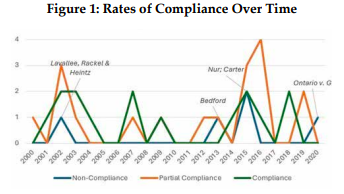
Figure 1 shows that most judicial rulings on Charter issues are met with high levels of compliance. In 86.8 per centre of cases, we see full or partial compliance, with legislatures rarely substantively deviating from the Court’s decision. In response to cases where a relevant remedy was prescribed, legislatures fully complied in 42.1 per cent of cases (16 cases), partially complied in 44.7 per cent of cases (17 cases), and did not comply in 13.2 per cent of cases (5 cases).
Notably, these cases of non-compliance covered issues of medical assistance in dying (Carter v. Canada [2015]), sex work (Canada v. Bedford [2013]), mandatory minimum sentences (R. v. Nur [2015]), the sex offenders registry (Ontario v. G [2020]), and solicitor-client privileges (Lavallee, Rackel & Heintz v. Canada [2002]). All of these cases of non-compliance were in the area of criminal law and most presented a controversial area of law. However, the cases of partial compliance were in response to a broad range of areas and were primarily technical legal issues. Five of these cases were in criminal law, focussing on issues such as denial of bail (R. v. Hall [2002]), search and seizure (R. v. Tse [2012]), possession of marijuana (R. v. Smith [2015]), sentencing (R. v. K.R.J. [2016]), and child luring (R. v. Morrison [2019]). The majority of these cases of partial compliance focussed on the administration of the criminal justice system. At the same time, the other cases of partial compliance were in more technical areas of law, such as civil, constitutional, electoral, administrative, and immigration. Of the cases of compliance, criminal and labour cases respectively composed 26.7 per cent of the cases, while the rest of the cases of compliance were in areas of administrative, civil, constitutional, and immigration law. The cases of criminal law focussed on the ability of an accused to stand trial due to a mental disability (R. v. Demers [2004]), early parole (Canada v. Whaling [2014]), bail and sentencing (R. v. Safarzadeh-Markhali [2016]), mandatory minimum sentences (R. v. Lloyd [2016]), and victim surcharges (R. v. Boudreault [2018]). The labour cases focussed on the right to collective bargaining (Mounted Police Association of Ontario v. Canada [2015]), pay equality (Quebec v. Alliance du personnel professionnel et technique de la santé et des services sociaux [2018]), the collection of personal data of striking employees (Alberta v. United Food and Commercial Workers, Local 401 [2013]), or the ability for a union to strike (Saskatchewan Federation of Labour v. Saskatchewan [2015]). As with in the cases of partial compliance, the cases of strict compliance are in more technical areas of criminal law or focus on uncontroversial areas of policy.
It is notable that we observe higher levels of partial compliance, which introduces a higher degree of variability in the legislative response compared to Macfarlane’s previous study on legislative deviation. By incorporating a gradation of measuring compliance on a three-point scale, this operationalization allows for a more nuanced understanding of both the types of compliance with the Court, and the frequency of this “à la carte” compliance. Legislatures continue to align themselves with the Court’s ruling, but adopting a scale of compliance shows that legislatures will not fully align their legislative responses with the Court. Although the rate of non-compliance aligns with previous studies (fewer than one-fifth of cases),29 the rate of partial compliance sheds new light on the variety of legislative responses to Supreme Court decisions and legislatures’ willingness to strictly comply with the Court.
Studying Compliance in the Future
This study, while brief, represents a first attempt to import the logic and conceptualization of legislative compliance and deviation to the Canadian context. While previous work, such as that of Macfarlane and Morton make critical observations about the likelihood of parliamentary non-compliance from the courts’ rulings and the norms around which the legislative-judicial relationship has been built, there remains considerable room to improve our understanding of when and why legislatures choose to deviate from judicial decisions. This article represents an essential first step in that empirical project.
We suspect that reasons for non-compliance are manyfold and often highly political. Non-compliance may be more likely to occur around issues where there is an observable or pronounced gap between public opinion and the court’s opinion (e.g. in R. v. Brown where the SCC restored an Alberta man’s acquittal for attacking a woman while in a state of automatism), around issues where government has promised either in a campaign or budget a policy outcome that is incongruent with the court’s ruling, or in instances where the court is striking down instances of the government’s own legislative agenda (as opposed to a statute passed by a previous government – co-partisan or out-partisan). On the surface, we see too few cases on rights-related decisions to show systematic evidence of this reasoning, but there may be sufficient qualitative evidence to suggest that such patterns exist. This is a fruitful area for future research.
While our study excludes compliance by administrative bodies, the Court’s impact on policy and subsequent rates of compliance can extend well beyond the legislative sphere. Our contribution here is to make a case for a more systematized way to measure legislative compliance. Though rare, legislative non-compliance is a critical action on behalf of legislatures because it represents an upending of the classical understanding of the separation of powers. On its face, it may provoke consternation in some quarters. Legislatures which routinely flout the courts rulings are certainly operating outside of the bounds set out for them in the separation of powers. However, non-compliance – in the rare instances that we see here – may be reflective of something else far less insidious to the practice of democracy. When done with a credible reasoning, the legislature’s choice to deviate from judicial decisions, in whole or in part, may represent a type of public responsiveness that is consistent with democratic practice. Of course, like many things, such reasoning exists within narrow bounds that must be carefully delineated because they are far too easy to push. Consequently, it is critical to understand how to measure legislative compliance, so we collectively share a common definition of when these phenomena are happening. This allows the academic and legal community to be more clear-eyed if and when governments push their discretion too far.
Notes
- White, Linda A. “Federalism and Equality Rights Implementation in Canada.” Publius: The Journal of Federalism 44(1), 2014: 157-182. Doi: 10.1093/publius/ pjt019
- Kapiszewski, Diana, and Matthew M. Taylor. “Compliance: Conceptualizing, Measuring, and Explaining Adherence to Judicial Rulings.” Law & Social Inquiry 38(04), 2013, p. 806. Doi:10.1111/j.1747-4469.2012.01320.x.
- Paulson, Colter. “Compliance With Final Judgments of the International Court of Justice Since 1987.” American Journal of International Law 98(3), 2004, p. 435. doi:10.2307/3181640.
- Kapiszweski and Taylor, p. 816.
- Gauri, Varun, Jeffrey K. Staton, and Jorge Vargas Cullell. “The Costa Rican Supreme Court’s Compliance Monitoring System.” The Journal of Politics 77(3), 2015: 774–86. doi:10.1086/681260.
- Kapiszweski and Taylor, p. 816.
- Yildirim, Engin, Mehmet Fatih Sert, Burcu Kartal, and Suayyip Çalis¸. 2023. “Non-Compliance of the European Court of Human Rights Decisions: A Machine Learning Analysis.” International Review of Law & Economics 76, 2023: 1–20; Driscoll, Amanda, Aylin Aydin-Cakir, and Susanne Schorpp. “Public (In) Tolerance of Government Non-Compliance with High Court Decisions.” Comparative Politics 57(1), 2024: 71–90; Carlin, Ryan E., Mariana Castrellón, Varun Gauri, Isabel C. Jaramillo Sierra, and Jeffrey K. Staton. “Public Reactions to Noncompliance with Judicial Orders.” American Political Science Review 116(1), 2022: 265–82. doi:10.1017/S0003055421000903.
- Yıldırım et al., p. 3.
- Ibid, p. 12.
- Driscoll et al.
- Carlin et al., p. 278)
- Carlin et al.,; Gauri, Staton, and Cullell,; Gibson, James L., Milton Lodge, and Benjamin Woodson. “Losing, but Accepting: Legitimacy, Positivity Theory, and the Symbols of Judicial Authority.” Law & Society Review 48(4), 2014: 837–66. doi:10.1111/lasr.12104.; Krehbiel, Jay N. 2021. “Do Voters Punish Noncompliance with High Courts? A Cross-National Analysis.” Politics 41(2), 2021: 156–72. doi:10.1177/0263395720935368.; Simmons, Beth A. “Capacity, Commitment, and Compliance: International Institutions and Territorial Disputes.” Journal of Conflict Resolution 46(6), 2002: 829–56. doi:10.1177/002200202237931.; Staton, Jeffrey K. “Judicial Policy Implementation in Mexico City and Merida.” Comparative Politics 37(1), 2004: 41. doi:10.2307/4150123.; Staton, Jeffrey K, and Georg Vanberg. “The Value of Vagueness: Delegation, Defiance, and Judicial Opinions.” American Journal of Political Science 52(3), 2008: 504–19; Tyler, Tom R., and Kenneth Rasinski. “Procedural Justice, Institutional Legitimacy, and the Acceptance of Unpopular U.S. Supreme Court Decisions: A Reply to Gibson.” Law & Society Review 25(3), 1991: 621–30. doi:10.2307/3053729; Zink, James R., James F. Spriggs, and John T. Scott. 2009. “Courting the Public: The Influence of Decision Attributes on Individuals’ Views of Court Opinions.” The Journal of Politics 71(3), 2009: 909–25. doi:10.1017/ S0022381609090793.
- Murphy, Kristina, and Tom Tyler. “Procedural Justice and Compliance Behaviour: The Mediating Role of Emotions.” European Journal of Social Psychology 38(4), 2008: 652–68. doi:10.1002/ejsp.502; Naurin, Daniel, and Øyvind Stiansen. “The Dilemma of Dissent: Split Judicial Decisions and Compliance With Judgments From the International Human Rights Judiciary.” Comparative Political Studies 53(6), 2020: 959–91. doi:10.1177/0010414019879944.
- Vanberg, Georg. The Politics of Constitutional Review in Germany. Cambridge, UK ; Cambridge University Press, 2005.
- Andrea Lawlor and Erin Crandall, Public Support for Canadian Courts: Understanding the Roles of Institutional Trust and Partisanship, 2022 37-1 Canadian Journal of Law and Society 91, 2022.
- Stiansen, Øyvind. “Directing Compliance? Remedial Approach and Compliance with European Court of Human Rights Judgments.” British Journal of Political Science 51(2), 2021: 899–907. doi:10.1017/ S0007123419000292, p. 900.
- Schroeder, Philipp. “Pushing Boundaries: How Lawmakers Shape Judicial Decision-Making.” Comparative Political Studies 55(14), 2022, p. 2469.
- Hogg, Peter W, and Allison A. Bushell. “The Charter Dialogue Between Courts and Legislatures (Or Perhaps the Charter of Rights Isn’t Such A Bad Thing After All).” Osgoode Hall Law Journal 35(1), 1997: 75–124.
- Morton, F.L. “Dialogue or Monologue?” Policy Option 20(3), 1999: 23–26.
- Macfarlane, Emmett. “Dialogue or Compliance? Measuring Legislatures’ Policy Responses to Court Rulings on Rights.” International Political Science Review 34(1), 2013: 39–56. doi:10.1177/0192512111432565.
- Benesh, Sara C., and Malia Reddick. “Overruled: An Event History Analysis of Lower Court Reaction to Supreme Court Alteration of Precedent.” The Journal of Politics 64(2), 2002: 534–50. doi:10.1111/1468-2508.00138.
- Kapiszweski and Taylor, p. 806.
- Hawkins, Darren, and Wade Jacoby. “A Comparison of the European and Inter-American Courts of Human Rights.” Journal of International Law and International Relations 6(1), 2010: 35–86; Hillebrecht, Courtney. “Rethinking Compliance: The Challenges and Prospects of Measuring Compliance with International Human Rights Tribunals.” Journal of Human Rights Practice 1(3), 2009: 362–79. doi:10.1093/jhuman/hup018; Hillebrecht, Courtney. “Implementing International Human Rights Law at Home: Domestic Politics and the European Court of Human Rights.” Human Rights Review 13(3), 2012: 279–301. doi:10.1007/s12142-012-0227-1; Huneeus, Alexandra. “Compliance with Judgments and Decisions.” In The Oxford Handbook of International Adjudication, eds. Cesare P. R. Romano, Karen J. Alter, and Yuval Shany. Oxford University Press, 2014: 437–63. doi:10.1093/law/9780199660681.003.0020; Kapiszewski and Taylor, p. 806; Naurin and Stiansen.
- Hillebrecht, 2012, p. 285.
- Kirkby, C., & Valiquet, D. Legislative Summary for Bill C-55. Library of Parliament, 2013. URL: https:// lop.parl.ca/sites/PublicWebsite/default/en_CA/ ResearchPublications/LegislativeSummaries/411C55E
- Kapiszewski and Taylor, p. 810
- Anagnostou, D., and A. Mungiu-Pippidi. 2014. “Domestic Implementation of Human Rights Judgments in Europe: Legal Infrastructure and Government Effectiveness Matter.” European Journal of International Law 25(1), 2014: 205–27. doi:10.1093/ejil/chu001.; Hawkins and Jacoby, p. 42; Huneeus, p. 445.
- Anagnostou and Mungiu-Pippidi, p. 213.
- MacFarlane.