

So Many Faces, So Many Stories: The History of Queen’s Park’s Premier Portraits and the Legacy They Reveal
From incorporating significant items to an artist’s choice of how to depict their subject, Ontario’s Premier portraits are a unique window into the province’s political history and culture. In this article, the author provides a brief history of these works of art and speaks to two artists who painted some of the more recent portraits to explain a trend in which premiers have sought to highlight the “personal” while honouring the “political.”
Geneva Fuina
Geneva Fuina is a 2025-2026 participant in the Ontario Legislature Internship Programme. She served as an editorial intern for the Canadian Parliamentary Review as a part of her internship.
The long-standing convention holds that a picture is worth 1,000 words. Well, if this is true, then one must wonder what a life-sized custom portrait says about Ontario’s Premiers? In many ways, Queen’s Park functions as a living museum, a time capsule preserving the political history of the province. The second floor, where the hallways are lined with portraits of past Premiers, is a gallery of stories to be told. One way of revealing the legacy they leave behind is through the personal objects Premiers include in their portraits, and this is where our story unfolds.
After Confederation, the government set out to build a new Legislative Building: the Pink Palace we know and admire today. However, when its doors first opened, the interior was quite different; despite the gleam of new furniture, the halls were bare, awaiting the life and legacy that would soon fill them. The first portrait to enter Queen’s Park on April 4, 1893, its official opening day, was that of Oliver Mowat, painted by Robert Harris.1 The portrait, commissioned and donated by the “friends of the Premier,” was brought from the former location on Front Street West, and marked the beginning of a tradition honouring Ontario’s leaders within Queen’s Park.2
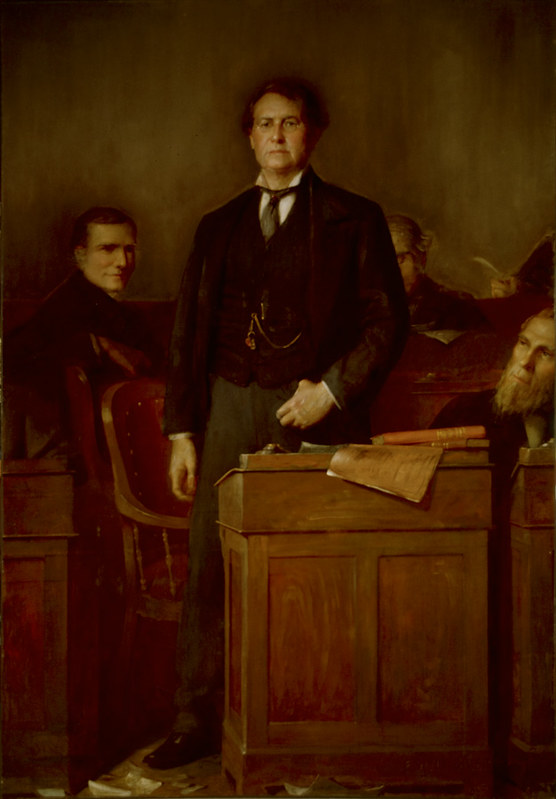
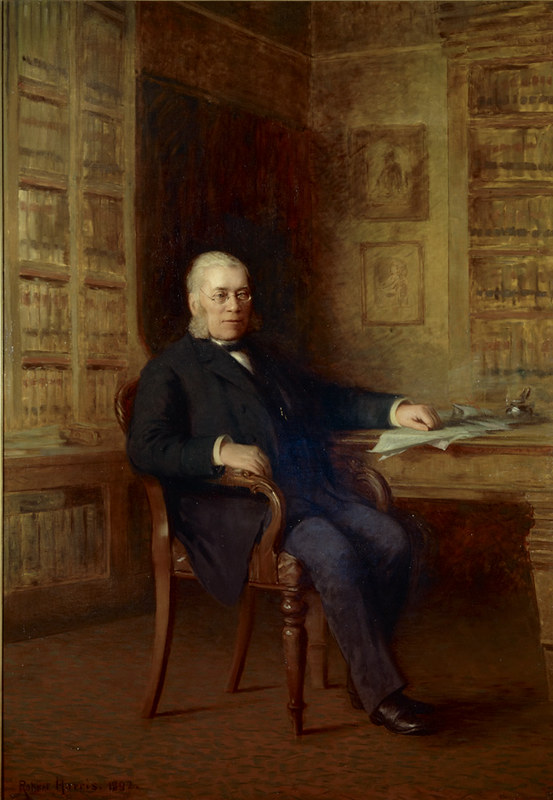
The tradition of commissioning portraits of prominent political figures spans governments worldwide and serves many purposes. Indeed, it serves as a means of decorating the building, and it is for this reason that earlier portraits are considerably bigger as an attempt to occupy the empty walls. Further, they are a gesture of gratitude, serving as gifts for service when a Premier reaches the end of their tenure. All encompassing, portraiture embodies the history of the province and, by extension, serves a key educational function. As historical and biographical artifacts, they reveal changing leadership and invite insights into the personality of their subject, depicted through the objects that symbolize their legacy and values.
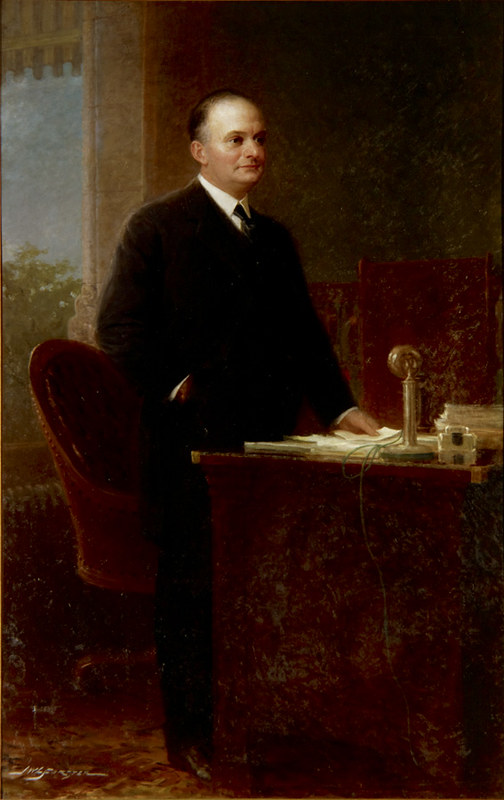
The practice of including personal items is not unique to the most recent portraits but rather is evidenced in portraiture that pre-dates Confederation. Notably, George Brown (1851-1865) is seen holding papers from The Globe, the newspaper he founded, known today as The Globe and Mail. The portrait of Edward Blake (1871-1872), the second to be hung on the walls of Queen’s Park, is the only one to depict a Premier in the Chamber. In a similar sentiment, Oliver Mowat’s (1872-1896) portrait features his home library as the backdrop. A phone can be seen on the desk in the portrait of Ernest Drury (1919-1923). The portrait of George Henry (1930-1934) features a window framing the Whitney Block, a building beside Queen’s Park, for which Henry was involved in its creation.
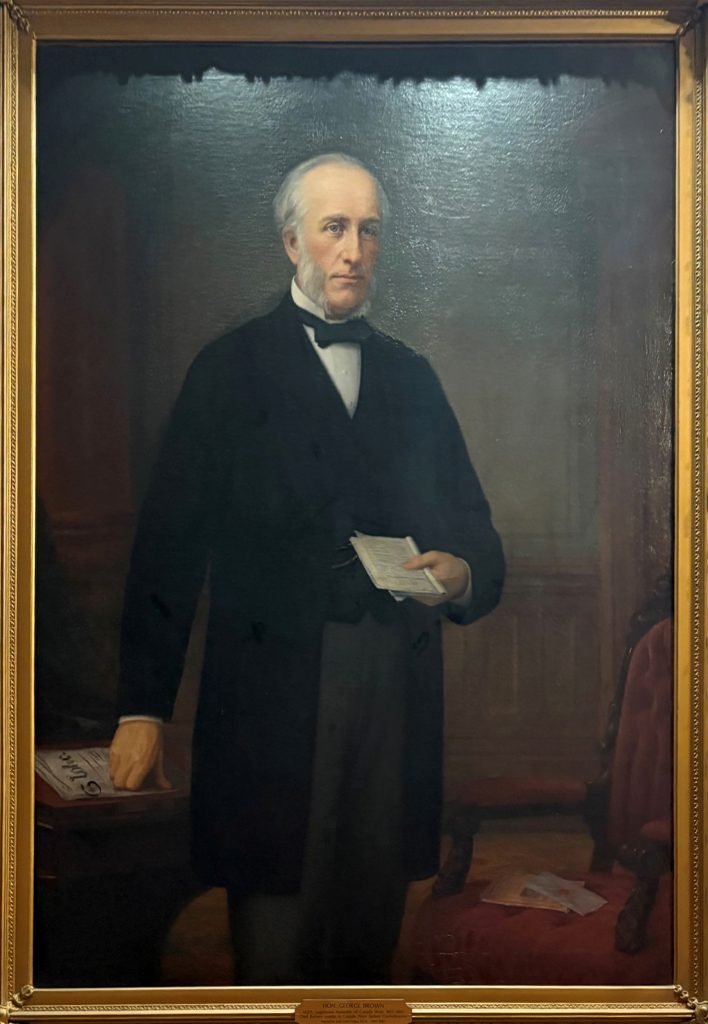
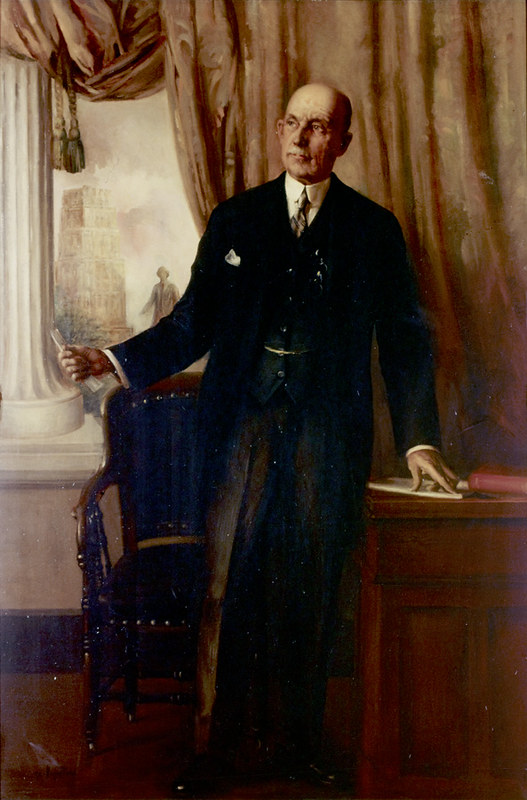
The portraits are not rigid, standardized reproductions; indeed, they evolve over time and reflect personal choices about how the subject is depicted. While some remain formal, presenting the Premier alone against a unified plain background, others incorporate elements of personal significance. Prior to the 1980s, such inclusions were subtle and relatively rare. A notable shift emerged, however, with the work of portrait artists Linda Dobbs and Phil Richards, whose contributions transformed portraiture at Queen’s Park; not only did the number of personal objects increase, but the emotional depth and sentiment behind them became more pronounced.
I had the privilege of interviewing both Linda and Phil, whose reflections offered insights on their artistic choices and processes that inform their nuanced approach to portraiture at Queen’s Park. In understanding the motivation underscoring this shift, Phil expressed “it was a very different attitude that I brought to the collection at Queen’s Park and really any other collections I have been in.” The use of symbolism is an integral component of Linda’s artistic vision, especially in portraiture, as she expressed, “my whole purpose is that three hundred years from now if somebody looked at the portrait, they would know the time the person was living in and the human being they were looking at.” The use of symbolism allows the artists to encapsulate the subject’s “inner soul and personality,” as Linda describes, allowing the viewer to generate a sense of resonance with the subject and an understanding of their humanity.
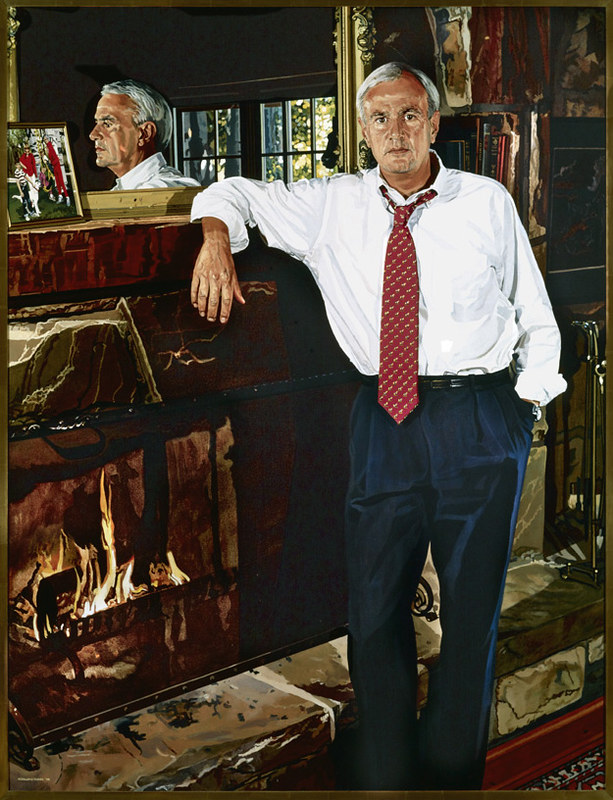
The portrait of David Peterson (1985-1990) ushered in a distinctive style of portraiture. I had the pleasure of speaking with Mr. Peterson, who enthusiastically shared that he wanted his portrait to be “different and more personal.” This artistic liberty is reflected in his portrait, painted by Linda Dobbs, who explained that before beginning her work, “I need to know a lot about the person, a lot about how they feel they should be remembered in history, what objects represent them.”3 The portrait reflects this sentiment as Mr. Peterson shared with me the stories behind the objects he chose to stand beside. First and foremost, a framed photograph of his family and dog sits atop the fireplace mantel. The fireplace and mantel serve more than a decorative function, as Linda described; they represent Mr. Peterson’s astrological signs: the stone symbolizes Capricorn, an earth sign, while the fire represents Sagittarius. In the background, a stack of books can be seen, and as Mr. Peterson shared with me, if you look closely, the spines are labelled with the initials of his parents. The former Premier is depicted not in a formal dress suit but wearing a loose tie adorned with horses, and in the mirror, the head of a horse peeks through the window. The horses appear as a nod to his wife, Shelly Peterson, who enjoys riding, breeding, and training horses and has authored nine books on the subject. Indeed, Shelly was out riding her horse when Linda arrived at their home, which inspired her to include these elements in the portrait. The portrait, set at the family’s farmhouse in Caledon, captures the Ontario fall colours that shine through the window, which, as Mr. Peterson shared with me, he was eager to include.
To capture the personal and political life of Mr. Peterson, Linda begins her process with several conversations to understand her subject’s personality, explaining, “I need to draw out the information onto the canvas.” The element of symbolism is key to Linda’s work, which can be traced back to her earlier days as an illustrator, as she shared, “I used to put my friends in my illustrations, and they were pleasantly surprised.”
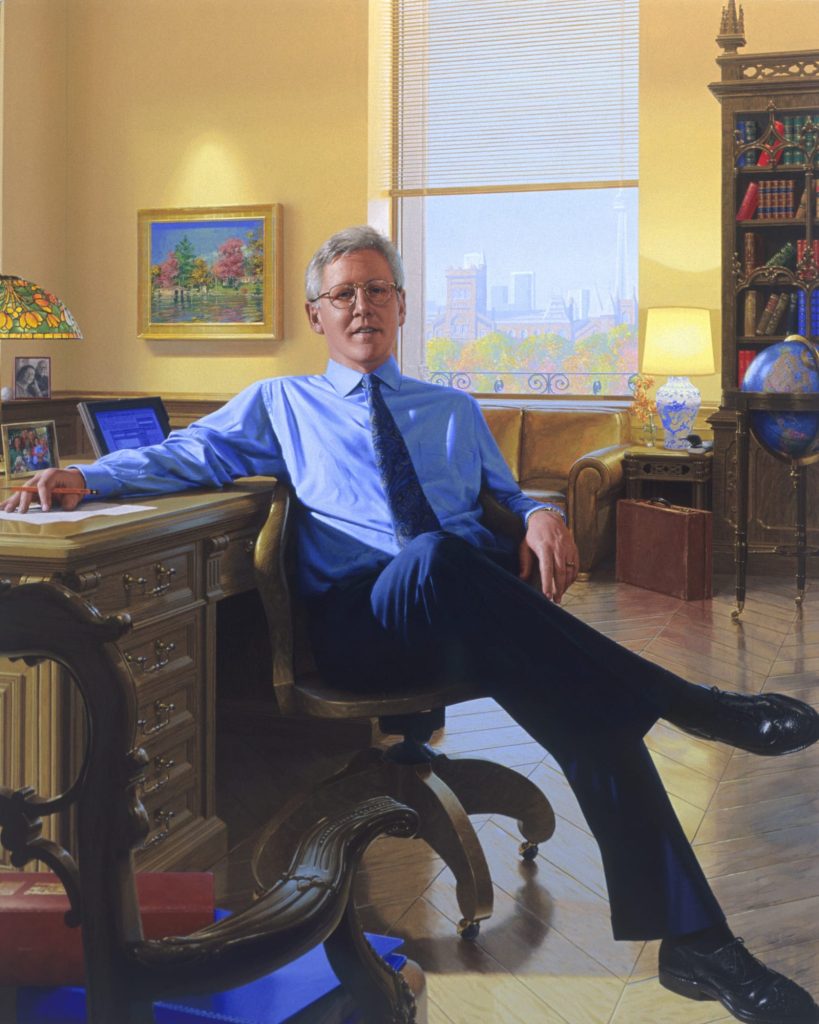
The portrait of Bob Rae (1990-1995), painted by Phil Richards, features framed family photographs atop the desk, alongside a laptop, which was included to signify that he was the first Premier to computerize his office. The subtle rays of sunlight streaming on Mr. Rae serve as a homage to his father’s time spent on the vaudeville stage alongside his sister and brother in an act named “The Three Little Raes of Sunshine.” On the back ledge sits a lamp with a base shaped like a baseball bat, which is seen touching the baseball that sits to its right. In the distance hangs a landscape of Mr. Rae’s cottage in the autumn season, and Phil revealed that the surrounding gold frame originated in the portrait itself, only later being created in real life. The orange lilies serve as a tribute to the first NDP Premier, referencing the party’s signature colour, and the loon sculpture to its right was a request made by Mr. Rae’s wife, Arlene Rae. Remarkably, the cabinet never existed in real life and was imagined by Phil as an English antique to symbolically reference Mr. Rae’s time studying at Oxford. Through the window, both the CN Tower and the University of Toronto Campus are visible; however, these sights cannot be seen together from Queen’s Park and were included to represent his time at the university. An interesting fact often shared on art tours is that the shoes Mr. Rae wears in the portrait belong to the artist. While technically true, Phil clarified the full story: the shoes belonged to his father, who purchased them in London, England, in the early 1940s when he was stationed there during the war. They came to be in the portrait as Mr. Rae’s shoes were too worn, so Phil suggested that he paint on his father’s wing-tip shoes, which, fun fact, are actually brown but painted black. Little did Phil’s father imagine that one day his shoes would be featured in a Premier’s portrait.
The range of personal and political items of significance “speaks not just to his time as a Premier but his whole life in a way,” Phil shared. The process of creating a symbolically rich portrait relies on collaboration: “I always tell my sitter that you and I can make a better painting than I can make on my own.” The inclusion of personal objects of importance evokes a deeper understanding of the subject, just as Phil intended, as he received “immediate feedback in terms of the humanization of the sitter in this portrait.”
This portrait, Phil described, “was a pivotal painting for me and for the art of portraiture. I think it marked a change in the attitude towards portraiture. One of the reasons I did that and worked so hard to change the look of the portraits was because I wanted to revive the art of portraiture, which had really fallen on hard times by the middle of the 20th Century.”
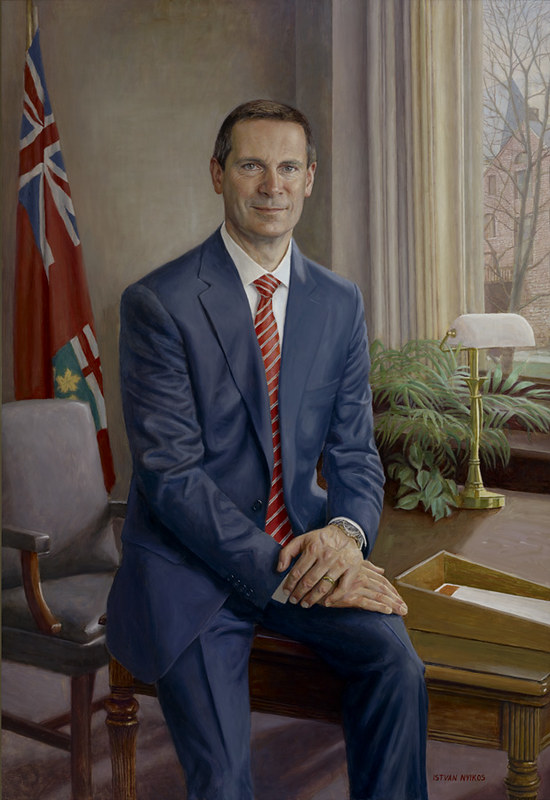
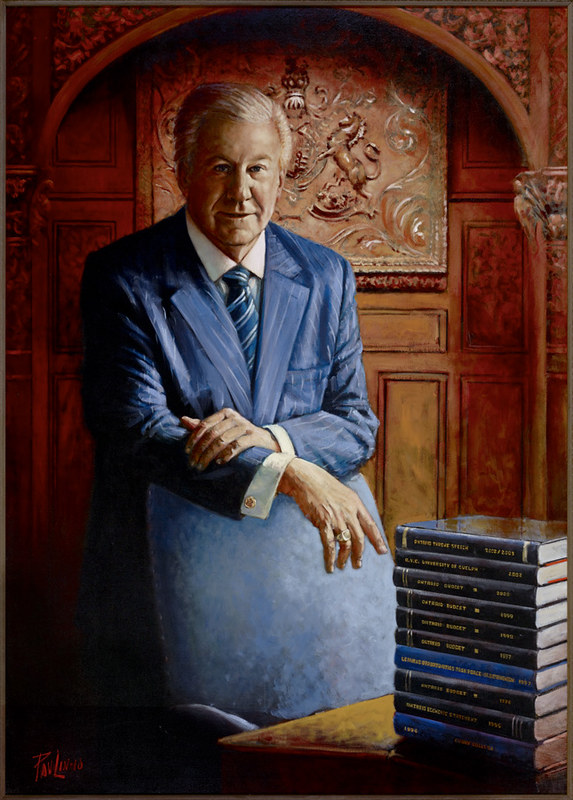
The portrait of Ernie Eves (2002-2003) features the Speaker’s dais in the background, along with a stack of books representing his political achievements, including the budgets he introduced. In Dalton McGuinty’s (2003-2013) portrait, the legislative building can be seen through the window, along with the daily news clippings atop his desk.
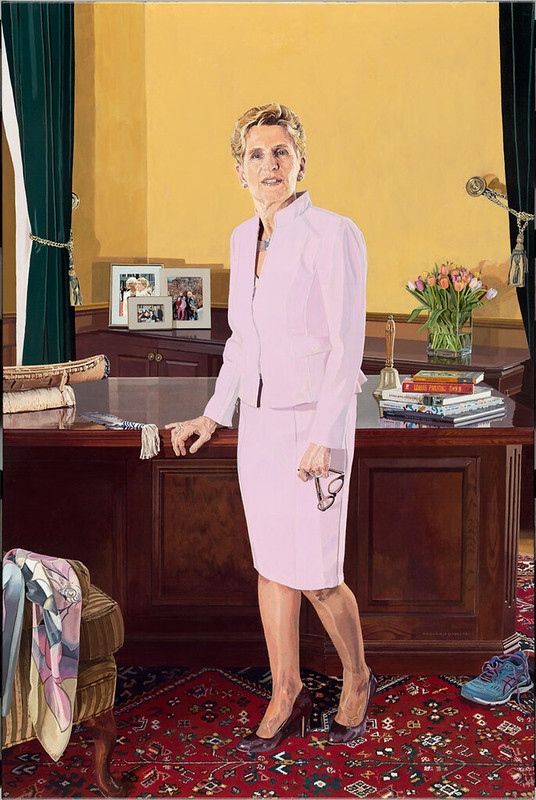
The most recent Premier portrait is that of Kathleen Wynne (2013-2018), painted by Linda Dobbs, and is rich with personal symbolism. “I talked to her about objects that mattered to her,” says Linda, who included framed photographs that showcase Ms. Wynne’s three children, grandchildren, and life partner, Jane Rounthwaite. On the desk sits an eagle feather, a gift from a group of Indigenous women, alongside a canoe, representing her dedication to fostering positive relationships with Indigenous communities. Further, there sits a stack of books, including a lesbian parenting book in which Ms. Wynne and Jane co-authored a chapter and a book on the history of Richmond Hill, her hometown. A vase of tulips is a homage to the years she lived in the Netherlands, where two of her children were born, while a scarf draped over a chair hints at her fondness for scarves. Moreover, as the first woman Premier, Linda expressed “I felt it was important for her to be feminine” as she is seen “wearing heels and a beautiful pink suit.” A running shoe can be found beneath her desk, as Ms. Wynne was a “great athlete and I wanted that to be represented in some way,” shared Linda. Indeed, the former Premier can be remembered for having run laps around Queen’s Park.
These portraits reflect not only the political accomplishments of each Premier but also facets of their personal lives. In a conversation with David Bogart, Communications Officer, he shared that visitors are drawn to the portraits that contain personal items. He described the fascination as “curiosity mixed with commentary,” noting that many make personal connections to the objects and spend a considerable amount of time admiring the portraits. This phenomenon reflects the sentiment held by Phil, who explained, “that is what this kind of portrait can do: let people see that the person who was the Premier and took on that role and made a great effort to do the best in it, is also a human being. Before and after their leadership role, they have a life, family, interests, [and] problems as they move through life. It humanizes these leaders we have depended on and so often been critical of or praised what they have done. But at the end of the day, once they leave that leadership role, they become human again.” Through the inclusion of personal items, the subject’s essence fully occupies the canvas. As Linda expresses, “subtly translating an emotion is my motivation…it is very rewarding when the subject appreciates your vision of them, and depth is important to me. It’s not just a likeness, there is something else, a more interior view that you need to bring out, and I find it very important to know and feel who this person is to be able to execute the portrait.” The artists of the portraits are deeply tied to the creation of these historic pieces and as Linda reflects, “to make a contribution to history and to be part of it is a great honour and I don’t take it lightly.” The Premier portraits that line the halls of Queen’s Park are more than dried paint on a canvas; they are living legacies tied to Ontario’s history.
If you are hurrying through the hallway, these details can easily go unnoticed. Next time you find yourself on the second floor of Queen’s Park, take a moment to study the portraits and discover the personal objects that speak volumes about the legacy each Premier wished to leave behind. And maybe, just maybe, you might find a few objects that escaped my eye!
Endnotes
1 Fern Bayer, “Faces of History: The Portrait Collection,” in The Ontario Collection. (Toronto, ON: Fitzhenry & Whiteside, 1984), 240.
2 Ibid., 159.
3 David Warner, “Interview with Linda Kooluris Dobbs,” in The Artists Who Created the Art at Queen’s Park, ed. David Warner. (Toronto, ON: The InFormer, 2018), 55.