

Casework Training for MP Staff: The Application of Learning Strategies and Instructional Design
The recruitment and onboarding of employees supporting parliamentary functions constitute a cornerstone of Members of Parliament’s success. While many MPs appoint former campaign volunteers, the skills required within a parliamentary context differ from those needed leading up to an election. A structured onboarding process—grounded in adult learning principles — bridges this gap and aligns staff competencies with the institutional framework of the House of Commons. This article outlines the strategy adopted by the Learning and Development Services of the House of Commons Administration to facilitate the integration of new Members’ employees. Drawing on a case study, the author examines each phase of the training design process—from initial needs analysis to the delivery of a recently implemented course entitled Introduction to Casework. This course, now included in the House of Commons training catalogue, aims to enhance the capacity of constituency office staff to effectively manage constituent inquiries and casework responsibilities.
Robin Bruneel
Robin Bruneel, B.A., M.A., is a Senior Learning Specialist working for the House of Commons Administration. Holding a Master’s degree in History and Communication and certified in Instructional Design, he is a member of the Learning and Development Services team that supports Members of Parliament and their staff at the House of Commons.
Contextual Overview
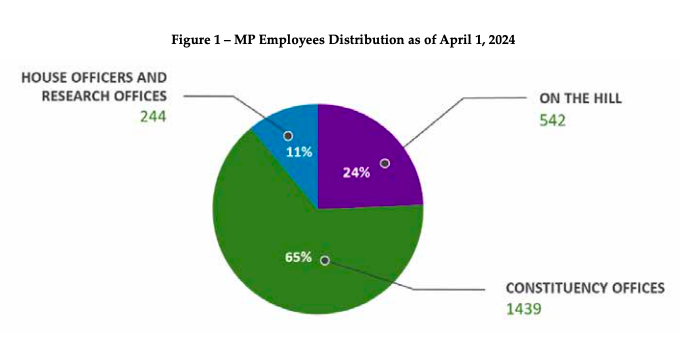
The recruitment of personnel to support Members of Parliament in their offices is a relatively recent development in the history of our institution. In December 1972, a central budget increase at the House of Commons allowed Members of Parliament, for the first time, to hire one—and subsequently two—secretaries to assist with their administrative tasks.1 This funding increase paved the way, in December 1973, for the official opening of the first constituency offices.2 Today, the steady influx of new parliamentary staff—commonly referred to as “staffers”—represents approximately 58 hires per month3. Each Member is typically supported by a team of six to eight employees who assist them in fulfilling their legislative, administrative, and representative duties, both in Ottawa and within their constituency. As of April 21, 2025, there were 2,225 employees supporting Members of Parliament across Canada, 65 per cent of whom were located outside the National Capital Region.
This workforce, now fully integrated into the parliamentary landscape, has grown steadily in both scope and influence. Newly added to the parliamentary landscape, it has gradually gained in importance and influence, prompting the Administration of the House of Commons to develop and enhance its integration processes in response to evolving institutional needs. In September 2020, the first iteration of an integrated and systemic program – the Member’s Employees Onboarding Program (MEOP) – was launched. While the Administration plays a central role in the onboarding of new employees, it is nevertheless important to note that responsibility for recruiting and managing staff remains the prerogative of Members of Parliament. Concurrently, each party or parliamentary office may also implement complementary onboarding initiatives tailored to its own practices and organizational objectives.
“My colleagues know better than most that every member of Parliament is supported by a dedicated staff. We could not otherwise do our job.”
Former MP Marc Garneau, March 8, 20234
Program Overview
The MEOP is a non-partisan initiative administered by the House of Commons Administration, designed to support the integration of all newly hired employees of Members of Parliament. The program is delivered entirely online to ensure accessibility for staff across the 343 federal constituencies. These employees are interconnected nationwide through the network established by the House of Commons.
The MEOP aims to facilitate and accelerate staff integration by equipping new hires with the necessary knowledge and resources, early in their onboarding journey. Its design, coordination, and delivery are overseen by a team within Human Resources: the Learning and Development Services for Members and their employees. This team offers similar onboarding programs to MPs both following elections and during the course of a parliamentary term. It is composed of specialists in adult learning and organizational development, who work in collaboration with various service areas on Parliament Hill, including experts in finance, budgeting, human resources, client relations, legal affairs, and security services, the Sergeant- at-Arms, operations teams, and procedure and IT support. The House of Commons Administration’s vision, One House, One Team, reflects the collaborative spirit underpinning the program.
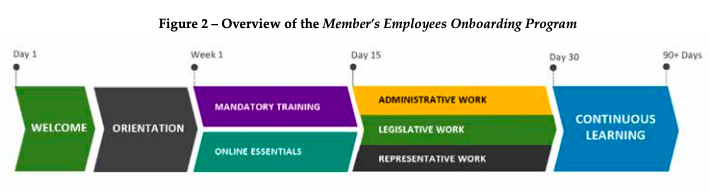
The program begins on the new employee’s first day, following a recruitment process that includes security checks. An online user account is created, granting access to the House of Commons network through equipment prepared and configured by IT services. The employee then receives a welcome email, followed by a call from a representative of the Administration to review initial procedures and register them for an orientation session. During this session, participants learn about the roles of Members of Parliament, the operations of the House of Commons, and the services and tools available to support their duties.
The learning journey then continues with the integration of mandatory courses stemming from the Canada Labour Code, essential training in security and technology, followed by learning based on other areas of parliamentary functions: administrative, legislative, and representational work.
Each stage of the program is reinforced through targeted communications from the Learning and Development Services team. The sequence is progressive and informed by a “just-in-time” learning approach, designed to deliver relevant information at the right moment to promote retention and application.
Following the orientation period, the employee may continue their professional development by exploring the catalogue of courses offered by the House of Commons, or by contacting the Learning and Development team to assess various options provided by external suppliers with agreements in place with the institution. Since 2022, a professional development fund of $5,000 per MP office has been made available annually. This initiative, approved by the Board of Internal Economy,5 enables MPs to finance training for their employees, with the aim of enhancing the competencies required to effectively support parliamentary functions.
A Case Study: Introduction to Casework Training
How is an onboarding and training program designed, and what is the specific role of a Learning Specialist in that process?
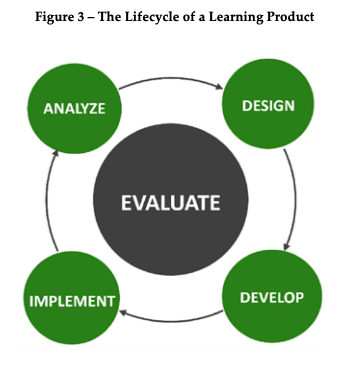
A Learning Specialist brings targeted expertise in project management, as well as organizational and program development. This includes instructional design models, techniques for information retention, presentation strategies, and core principles of andragogy and adult learning. Among the most widely used development models is the SAM (Successive Approximation Model) framework—an agile variant of the ADDIE (Analysis – Design – Development – Implementation – Evaluation) model, which has been a standard in the learning industry since its formalization at the University of Florida in the 1960s.
While many models exist and the socio-economic context of learners continues to evolve, the fundamental principles of learning remain largely constant: without practice, no retention; without active recall, no sustainable learning.
The model adopted for this case study, inspired by the SAM and ADDIE methodologies, encompasses the following stages of training development:
- Analysis: What are the learning gaps that need to be addressed? Who is the target audience? What learning objectives are we aiming to achieve? What resources are available to support the development process?
- Design and Development: What subjects and types of activities should be included to bridge the identified gaps? Which subject-matter experts are best positioned to lead instruction on these topics? How can information be presented to enhance its retention?
- Implementation: Through which delivery method will learners engage with the training? What format best supports the pedagogical goals of the program?
- Evaluation: What feedback did the learner provide on the learning activity? What residual gaps or areas for improvement are identified following the delivery of the training?
Origins of the Project
Much like the well-known adage “the customer is king,” one might say that in the field of learning, it is the learner who shapes the strategy and drives development efforts. For this reason, learner feedback is regularly solicited to monitor satisfaction levels and assess the relevance of available learning services. Through this ongoing consultation process, an increasing need for additional support in representational duties at the constituency level gradually emerged.
When the MEOP was launched in September 2020, priority had to be given to integrating core components—orientation and personnel needs—before the 2021 general election was called, which led to the postponement of further program development.
In this context, the Learning and Development Services team initiated a series of consultations beginning in spring 2022, starting with the Library of Parliament. With its recognized expertise and mandate focused on research and analysis services for staff both on Parliament Hill and in constituency offices, the Library became a key partner.
This initiative marked the beginning of a fruitful collaboration between the two institutions, which extended over a period of more than a year.
Analysis of the Learning Gaps
The purpose of the analysis phase was to identify the learning needs of employees working in MPs’ offices. Four key initiatives were undertaken: consultations with party Whips’ offices, a review of relevant academic literature, collaboration with other parliamentary institutions, and a series of interviews conducted with experienced caseworkers.
Results
Several insights emerged from these consultations:
First, the legal framework surrounding constituency work was found to be a foundational aspect of the role. In the absence of legislation defining what services MPs must provide, it is up to each Member of Parliament to determine the nature and scope of the assistance they offer, as well as how constituent information is managed. The protection of personal data is therefore paramount. To support this responsibility, the House of Commons provides standardized consent forms for the sharing of personal information, helping safeguard both citizens and constituency offices during case management (e.g., names, addresses, educational records, medical history, etc.). The Whips’ offices repeatedly emphasized the importance of these legal considerations. Accordingly, the development team was expanded to include legal professionals from the Office of the Parliamentary Counsel, who advise MPs on such matters.
The second theme to emerge was the importance of networking. The development team met with colleagues from the British Parliament and took part virtually in Westminster-hosted sessions designed for constituency staff. These exchanges demonstrated a highly collaborative environment, marked by fluid sharing of best practices, tools, and lessons learned — even among staff from different political parties.6
Lastly, interviews with experienced staff shed light on the complexity of working conditions in constituency settings. These offices are often the first point of contact for citizens expressing frustration with federal services, particularly in areas such as immigration or passport delivery, over which staff have little control. This environment can lead to emotional strain, with employees facing pointed criticism, verbal confrontations, or even physical threats.
In remote regions, some offices operate with only one or two staff members, contributing to a profound sense of isolation, especially in comparison to the activity and attention concentrated on Parliament Hill in Ottawa. Staff also reported facing pressure from constituents who, citing their electoral support, demand the resolution of issues beyond the office’s purview. These stressors can contribute to notable staff turnover. As a result, the report recommended strengthening connections with Human Resources advisors to address concerns related to organizational structure, workplace culture, and mental health, and to refer certain cases to security services when warranted.
Targeted Outcomes
Following the analysis phase, three primary learning objectives were established to guide skills development throughout the casework training course:
- To define the scope and legal parameters of constituent casework.
- To apply key principles and techniques for collecting constituent information.
- To navigate the tools and resources available to address requests and challenges within constituency offices.
Design and Development of the Training Material
Once learning needs have been identified, the Learning Specialist sets about designing an initial plan, much like an architect drafting the first blueprint of a structure. To do so, they draw upon a “toolbox” of instructional techniques, which we will now explore.
Retention and Engagement
Retention of information and the effective application of acquired skills represent the true battleground of pedagogy7—a Gordian knot shaped by the conditions under which learning occurs. Two criteria are essential to meet this challenge: the quality of the information conveyed, and the repetition of that information.
To this end, the training material is built around a microlearning approach: content is digested, structured, and broken down into small units to avoid cognitive overload. Structuring content is akin to chopping vegetables into slices and cubes—a way to make an otherwise unwieldy quantity more digestible and cohesive. Accordingly, online modules offered by the House of Commons typically do not exceed 60 to 90 minutes in duration. This approach both supports information retention and accommodates the demanding pace of parliamentary work, which rarely allows for extended periods of disengagement.
To the educator’s skill in content design must be added the art of repetition, which necessarily requires active participant engagement. One might recall the metaphor of linguist Kató Lomb, who likened knowledge to a nail: “If it is not driven in deep enough, it will give way under the slightest weight.” Given the limitations of virtual formats—and the parliamentary context, which does not permit formal evaluation systems as found in academic institutions—it falls on the facilitator to foster engagement through interaction, notably via questions and activities. This is, in essence, a Socratic approach: continuous questioning designed to elicit responses from participants and connect new information to prior learning.
Visual and Practical Learning
Often overlooked in instructional design is the use of visuals, which bolsters learning and plays a meaningful role in training, sometimes even contributing to the development of a distinct aesthetic in service of knowledge. Much like medieval scribes who adorned manuscripts to create a harmonious reading experience, visual design here becomes an empathetic, non-judgmental invitation for participants to engage more deeply with the material.
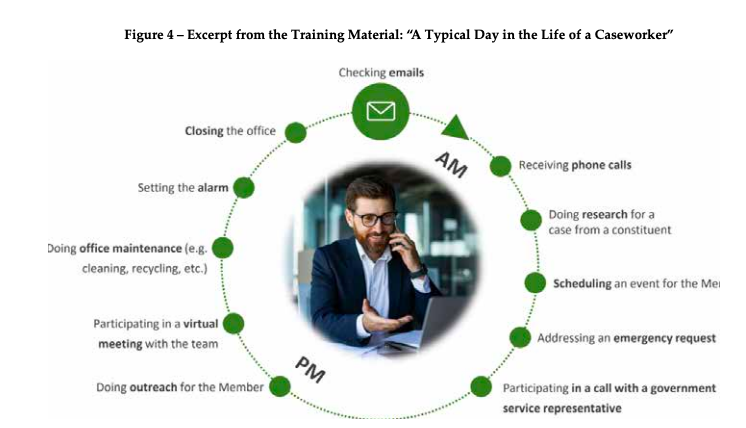
This pedagogical dimension naturally includes illustrations that help clarify key concepts. For instance, a constituency staff member may be called upon to perform a wide range of tasks throughout the day. A visual such as an “activity clock” can effectively depict the diversity of roles they take on beyond their formal job description: opening the office, organizing a local event, tidying the space, or offering a patient and empathetic ear to a frustrated constituent.
In the same spirit, the training is designed to be practical—for instance, it features a live demonstration of a research system, led by an Analyst from the Library of Parliament. This segment introduces participants to the available research tools and shows how to efficiently gather the information needed to respond to constituent inquiries. For example, participants learn how to identify funding programs for small and medium-sized businesses, or how to check the status of passport and immigration applications—two categories that emerged prominently during interviews as representing a significant share of requests received in constituency offices.
Implementation of the Course
Program implementation begins with preparing the team of experts who will deliver the training. As a first step, facilitators are invited to take part in a facilitation techniques workshop, offered through a Community of Practice—an initiative launched in 2022 within Human Resources. A tailored prep session follows, designed to meet the specific needs of the training. This session covers a range of facilitation methods as well as the logistical aspects of delivery: coordination among facilitators, division of learning content, and mastery of the material.
Since the session is delivered virtually, a refresher on the digital platform is also included. Facilitator notes—scripted or not—are provided to ensure consistency in messaging across sessions and to support facilitators in their preparation. Finally, a simulation or “dry run” is held to rehearse pacing and delivery, with mock participants posing questions and members of the learning team offering feedback.
Coordinating the annual training calendar at the House of Commons can be a genuine puzzle—a responsibility that lies primarily with the training coordinator. It requires careful consideration of MPs’ and staff schedules: sitting periods, committee work, caucus meetings, constituency events, and recess weeks all need to be taken into consideration. Added to this are learners’ language preferences and geographic locations, which can also affect timing.
While adjournment periods in the House of Commons typically offer legislative staff on Parliament Hill greater flexibility to participate in training, the opposite is true for constituency employees. During these periods, they are often engaged in coordinating local activities and supporting the Member’s presence in the riding. The development of training schedules must take these competing priorities into account in order to maximize client participation.
Evaluation of the Learning Product
Since the launch of the training on casework in September 2023, 269 Member’s employees have completed the course.8 The program received an average satisfaction score of 4.6 out of 5. Several participants expressed appreciation for learning about tools available to support their work in constituency offices—resources that were previously unknown to them or only superficially understood (e.g., “I really enjoyed learning what the Library could do for us […] and where to find funding options.”). Feedback also highlighted the significance of the legal aspects addressed during the training (e.g., “It was helpful to learn what I can do as a caseworker and what I can’t do.”). Finally, some attendees underscored the value of connecting with fellow staff in constituencies and the enrichment drawn from real-life examples and shared experiences (e.g., “My favorite part was hearing from experienced caseworkers and how they handled difficult situations.”).
Ongoing Development
In the field of instructional design, the lifecycle of a training program rarely exceeds three years. Beyond periodic updates, a full redesign is typically required, along with a fresh assessment of learning needs. A strong learning product is one that is evergreen—continuing to develop and adapt after its initial rollout.
For example, some participants have recommended the inclusion of additional modules on time management, as well as case study analysis related to newly introduced federal programs. The next phase of the project involves returning to the SAM model introduced earlier, and launching a new round of analysis. This includes a lessons-learned exercise with facilitators and subject-matter experts, followed by a thorough review of participant feedback. Additional interviews may also be conducted to stay attuned to the shifting realities of constituency offices.
Ultimately, the success of a training program cannot be measured solely by content retention. The greatest achievement of the Introduction to Casework course may lie in the fact that it now offers a forum for exchange and networking among constituency office employees (“We had never received formal training on casework before.”). Inspired by the British model we had the opportunity to observe, the course provides a platform for exchange—a non-partisan space for dialogue that fosters interactions among colleagues. It is an opportunity to bring together individuals who are “in the same boat,” speak a common language and face similar challenges, A Mari Usque Ad Mare.
Notes
- On this subject, we recommend consulting the studies by Peter MacLeod, published in the Canadian Parliamentary Review: “How to Organize a Constituency Office Effectively” (Spring 2006) and “The Constituency Project: Ten Years Later” (Summer 2014).
- Historically, MPs could rely on rotating secretarial support on Parliament Hill for administrative tasks, while presence in the constituency was typically ensured by the Member themselves—or in some cases, their spouse—when the parliamentary calendar allowed them to return to their riding (Real House Lives: Former Members of Parliament on How to Reclaim Democractic Leadership, Samara Centre for Democracy, 2020, p. 52).
- The figures cited here include all staff, whether hired on a short- or long-term basis, during the period from January 1 to December 31, 2024. Hiring peaks generally occur in May (the start of the fiscal year), at the beginning of a parliamentary session, or in the weeks following a general election.
- House of Commons Debates, Hansard no. 166, volume 151, March 8 2023 (Routine Proceedings, 1620).
- Composed of the Speaker and several members from both government and opposition, it meets approximately once a month to deliberate on budgets and administrative regulations governing internal House operations.
- For historical context, see coverage from the article: “MPs divided on the idea of public funding of riding offices,” The Ottawa Citizen, April 3, 1973.
- For the purposes of this article, we use the term pedagogy in its broadest sense, encompassing adult learning principles or andragogy, based on the definition provided by the Office québécois de la langue française.
- As of July 1, 2025. The training programs offered by the House of Commons Administration are available on a self-serve basis, at the request of clients. The only mandatory training sessions are those required under the Canada Labour Code, focusing on harassment prevention as well as workplace health and safety.