

Accessibility Measures at the Manitoba Legislature
The Legislative Assembly of Manitoba has made several accessibility adaptations to its work environment to meet the needs of its Members. Significant infrastructure enhancements like wheelchair ramps, procedural and technical adaptations enabling virtual participation, and measures to overcome auditory challenges have all helped to accommodate the individual needs of Manitoba MLAs.
Rick Yarish
In recent decades, society has become more attuned to and aware of the need to ensure that workplaces of all kinds are accessible and functional for everyone. The Manitoba Legislature has embraced this ethos and made a number of significant adaptations to its work environment to meet the needs of its Members.
Wheelchair Accessibility
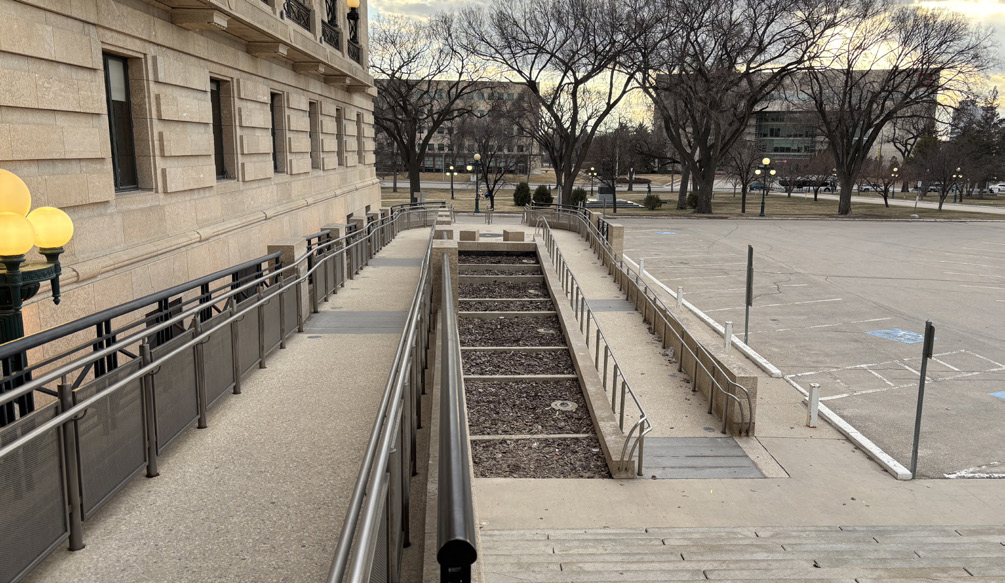
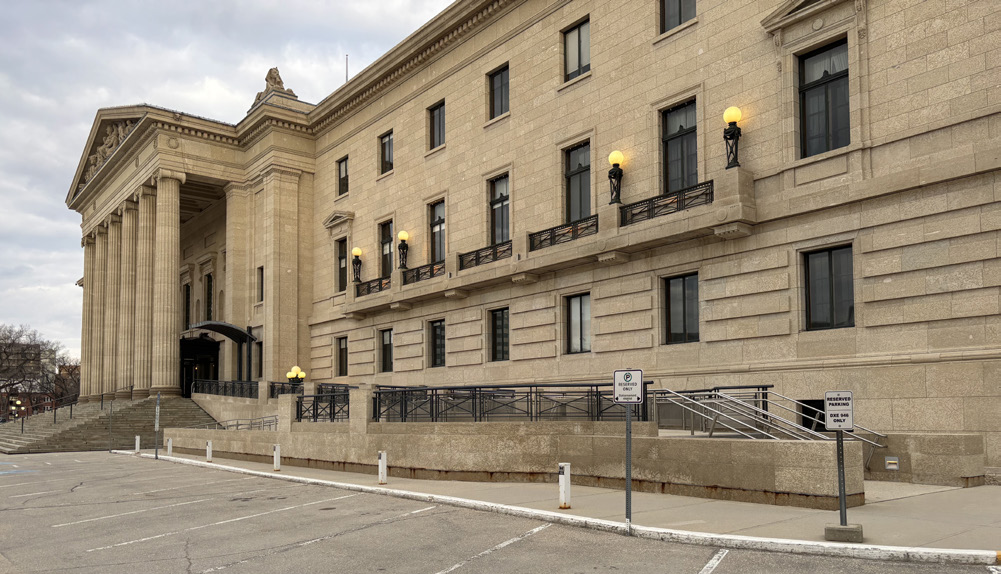
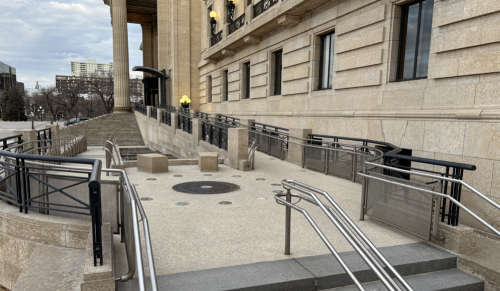
One of the first major accessibility initiatives came in 2007 with the installation of an exterior wheelchair ramp at the north (primary) entrance of the building. Prior to this, the only fully accessible entrances to the building were the east and west loading ramps. As these entrances were not suited for general access to the building and were certainly not as dignified as entering through the front doors, a fully functional ramp was designed to fit the historic architectural style of the building. The ramp is heated to avoid ice build up in the winter and was celebrated as an impressive achievement on the path to a more accessible legislature. This measure allowed anyone requiring a wheelchair or other mobility aid to enter the building through the front doors.
Alongside the discussion (and eventual construction) of an exterior wheelchair ramp, questions of wheelchair accessibility inside the building had also been considered for several years. There are three modern elevators in the building allowing full access to all four floors, however the central feature of the building – the Legislative Chamber – was not fully accessible. This problem came to a head in 2016 with the election of former MP Steven Fletcher, a quadriplegic who uses a wheelchair for mobility.
Following Mr. Fletcher’s election, an assessment of the Chamber’s lack of fullaccessibility led to the launch of a massive renovation project. In the original design of the Chamber, wheelchairs could only access the back row of Members’ seats. The first two rows of Members’ desks, and the Clerk’s Table in the well of the House, were inaccessible by wheelchair.
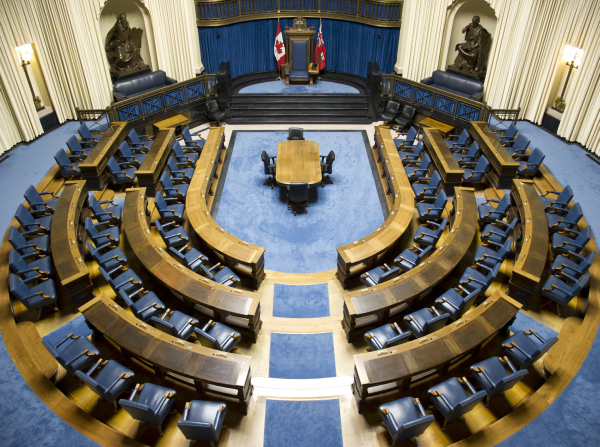
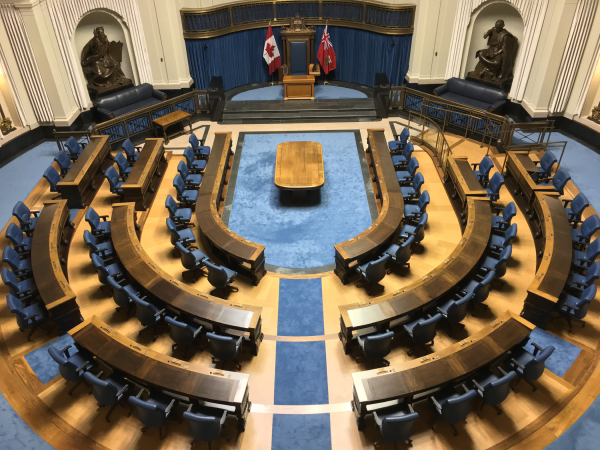
The renovation project in the summer of 2017 saw the Chamber completely disassembled and reconstructed. To create an appropriate grade for the ramp, the floor in the well of the Chamber was raised by almost three feet. The front benches were also moved about two feet closer to the center of the room to allow better wheelchair access to those seats.
The renovated Chamber re-opened in October 2017, 16 months after Mr. Fletcher’s election. The opening attracted significant media attention and eventually earned several awards, including the 2018 Heritage Winnipeg Preservation Award for Excellence and the 2018 Canadian Association of Heritage Professionals Award of Merit.
On a side note, a few other accommodations became necessary to ensure Fletcher’s ability to fully participate in Assembly proceedings. As had been done in the House of Commons when he was a Member of Parliament, our House agreed to allow Mr. Fletcher’s personal Aide to sit with him during all House or Committee proceedings. Further, we arranged for a panel to be installed at his seat to allow the Aide to signal the Speaker when he wished to speak in debate. Mr. Fletcher was not re-elected in 2019, but the Manitoba Legislative Chamber remains permanently accessible for any future Members requiring wheelchair access to all areas of the Chamber.
Hearing Issues
For many years now the Assembly made available neck loops which provided a wireless connection to hearing aids used by MLAs with hearing issues. Modern hearing aids are becoming ever more sophisticated, and some allow Members to connect directly with our Hansard audio output so that sound can be transmitted to a hearing aid.
Attention Deficit Hyperactivity Disorder with Auditory Processing Delay
In 2025 the Manitoba Assembly encountered an unprecedented situation with a recently elected MLA. Since their election in 2023 the Member discovered that, while serving in the Chamber during session, they had considerable challenges focusing in debate, especially in Question Period. The auditory stimulation in the Chamber was intense and difficult to process.
Last year the Member received a diagnosis of Attention Deficit Hyperactivity Disorder (ADHD) type 2. Specifically, the diagnosis was for a form of ADHD with Auditory Processing Delay (APD), a condition that affects the brain’s ability to process and interpret sounds, even when one’s hearing is normal. Individuals with APD may experience difficulty understanding speech, especially in noisy environments.
Not surprisingly, this condition created great challenges for this Member during Question Period. After their diagnosis the Member reached out to the Clerk’s Office to see if there were any supports we could offer. Following some productive conversations, a collaboration developed between the Member and Assembly Staff from several Branches who were eager to help. Our exceptionally capable Information Technology, Hansard and Digital Media staff find solving such problems rewarding and they were pleased to be able to assist this Member.
After considering a range of options the solution was fairly simple:
- We purchased a tablet for the Member’s exclusive use in the Chamber and positioned it on their desk.
- We connected the tablet to Hansard audio and set it to provide live transcription of proceedings.
Following some testing with recorded Chamber audio we tried the system live during session, and it was an immediate success. The tablet provides real time transcription of all words spoken on the record in the Chamber. The Member uses the tablet every day in the House, and Assembly staff maintain and test it prior to each sitting day. The Member shared that the live transcription has made a huge difference for them. They are able to process, comprehend and respond in debate without delay or confusion.
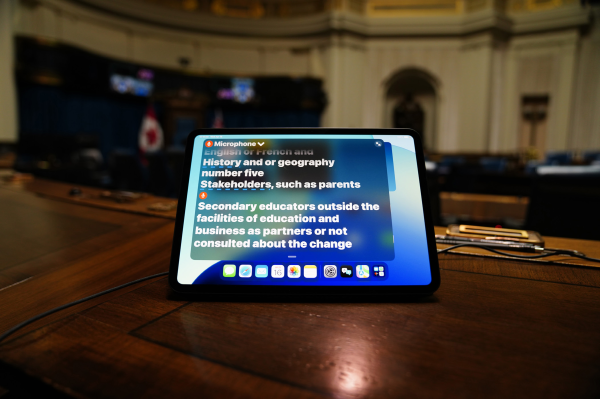
The Assembly has been pleased to develop this tool for the Member. Since implementing this measure, we have now provided a second tablet to another Member with hearing issues. They are also able to better follow and participate in House proceedings with the aid of the live transcription device. While the reason for needing the tablet is different with this Member, the tool provides an equally helpful solution.
Virtual Participation
The last accessibility measure worth noting from the Manitoba Assembly would be what I would describe as a “pandemic silver lining.” Like many legislatures around the world, during the COVID-19 Pandemic our Assembly developed and implemented the means for Members to participate in proceedings virtually. The processes for creating and executing the technical and procedural means to enable this were complicated, extensive and challenging. In October 2020 the House held its first virtual hybrid sitting, with Members participating both in the Chamber and virtually from their homes or offices.
Once the pandemic ended, Manitoba MLAs decided that they wanted to keep the virtual option permanently. In May 2024, the House adopted the procedural provisions which enable virtual participation as part of our Rules, Orders and Forms of Proceeding. In the modern Manitoba Assembly, Members may participate fully in proceedings whether they are in the Chamber, their home, their office or elsewhere.
We see virtual participation as a different kind of accessibility measure. While it is used by Members almost daily, we usually only have two or three Members participating virtually on a given sitting day. Most Members prefer to be in the building to participate in our debates. However, this accessibility option allows Members to do their jobs while attending to family needs, while recovering from medical conditions, or when they encounter other circumstances. All sides of the House approved of this measure, and it has been universally appreciated by Members.
Whether through significant infrastructure enhancements like wheelchair ramps, extensive procedural and technical adaptations like enabling virtual participation, or simpler steps like connecting a tablet to our audio system, the Manitoba Assembly has demonstrated its commitment to providing a workplace for our MLAs that is as accessible as possible. Undoubtedly we will receive more accessibility accommodation requests in the future, and I am confident that we will approach those challenges with the same determination and skill as we have applied in the past.
Rick Yarish is the Clerk of the Legislative Assembly of Manitoba.