
English Posts
Adapting New Communication Technologies at the Quebec National Assembly
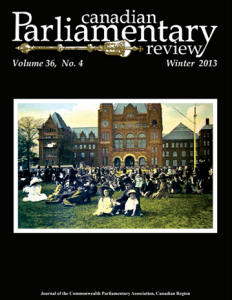 Adapting New Communication Technologies at the Quebec National Assembly
This article starts by looking at how the National Assembly has harnessed communications technologies to engage the public and get them involved in democratic life. It then focusses on the various technological tools available to members and the President to support them in their work. The article concludes with a few thoughts about how communications technologies have a tangible impact on parliamentary business.
Continue reading “Adapting New Communication Technologies at the Quebec National Assembly”
Children as Witnesses at Senate Committees: The Cyberbullying Hearings
Children as Witnesses at Senate Committees: The Cyberbullying Hearings
In December 2012, the Standing Senate Committee on Human Rights tabled its report Cyberbullying Hurts: Respect for Rights in the Digital Age. It followed a series of hearings in 2011 and 2012 where it closely examined the roles that stakeholders can play in addressing cyberbullying and the emerging best practices. The committee began this study by using the standard modus operandi for most parliamentary reviews – holding public meetings with experts, government officials, and representatives from stakeholder organizations. However, it was missing an important piece of the puzzle; the committee needed to hear from the children themselves. This article looks at how the committee went about the unusual task of hearing minor children as witnesses.
Continue reading “Children as Witnesses at Senate Committees: The Cyberbullying Hearings”
Time to Consider Abolition of the Senate
Time to Consider Abolition of the Senate
On November 6, 2013 the Legislative Assembly of Saskatchewan Assembly voted to repeal the Senate Nominee Election Act. Immediately thereafter the Premier introduced a motion that the Legislative Assembly of Saskatchewan supports the abolition of the Senate of Canada. Following speeches by the Premier, the Leader of the Opposition and other members the motion was adopted. The Government House Leader then asked the Speaker to transmit copies of the motion and verbatim transcripts to the Prime Minister of Canada and the leaders of the opposition parties in the House of Commons, as well as the premier of each Canadian province and territory. This article is a slightly abridged version of the Premier’s speech on the motion.
This is an important issue that we are about to debate in the Legislative Assembly. It is not the most important issue facing the province of Saskatchewan. For most people, it probably would not rank in the top twenty. So we are not going to spend a lot of time on the bicameral nature of our federal government and whether that should change. But we are going to make, I believe, an important pronouncement not just to our own provincial citizens to whom we are responsible, for whom we work, but I think as well to the country, to let them know that the province of Saskatchewan after some considerable deliberation — and not at all revolving around current affairs, though perhaps informed to some degree by them — have come to a view of what might be best for the country with respect to that bicameral parliament.
The Commonwealth Women Parliamentarians’ Celebrate Women’s Success
The Commonwealth Women Parliamentarians’ Celebrate Women’s Success
The Commonwealth Women Parliamentarians, as part of the larger Commonwealth Parliamentary Association, works towards better representation of women in legislatures throughout Canada and the Commonwealth. In July, the 2013 Steering Committee Meeting and Conference of the CWP was held in Edmonton. This article looks at the agenda of the conference and strategic projects for the CWP (Canada).
Continue reading “The Commonwealth Women Parliamentarians’ Celebrate Women’s Success”
The Library of Parliament’s Research Service: Adding Value for Parliamentarians
The Library of Parliament’s Research Service: Adding Value for Parliamentarians
Canada has one of the libraries in the Commonwealth that provides the most complete range of research and analysis services to legislators. At a recent presentation to the International Federation of Library Associations and Institutions (IFLA) in Singapore, the Canadian Parliamentary Librarian outlined how Canada provides research support to parliamentarians. Over the years many countries have been impressed by the services available to Canadian parliamentarians and have inquired about considerations to keep in mind when establishing similar services. This paper summarizes the thoughts that were shared with international colleagues interested in establishing their own research service.
Continue reading “The Library of Parliament’s Research Service: Adding Value for Parliamentarians”
Absentee Voting Rights: The Case of Nigeria
Absentee Voting Rights: The Case of Nigeria
In 2012, six Members of Nigeria’s Federal House of Representatives led by Abike Dabiri-Erewa, House Committee Chair on Nigerians in the Diaspora sponsored a Legislative Bill that seeks to amend Nigeria’s Electoral Act 2010 in order to grant Nigerians in the Diaspora the right to vote during general elections in Nigeria. This article provides a detailed review of the provisions of the proposed legislation in order to ascertain and expand the rationale for the Bill, the advantages and disadvantages of the Bill, constitutional and legal issues around the Bill and a comparative analysis of similar legislation in other countries.
Nigeria’s Electoral Act 2010 is divided into 9 major Parts, 158 Sections and three Schedules. The Act provides for the establishment and functions of the Independent National Electoral Commission (INEC)1, the Procedure at Elections; National Voters Register and Voters Registration; Formation, Functions and Powers of Political Parties; Electoral Offences, among other things.
Continue reading “Absentee Voting Rights: The Case of Nigeria”
The Changing Use of Standing Order 31 Statements
The Changing Use of Standing Order 31 Statements
Standing Order 31s are permitted 15 minutes of the House’s floor time each day during which selected MPs can speak for a maximum of one minute each in order to draw attention to issues or events. These have often been used to congratulate groups or individual citizens, bring attention to a problem, or make a statement on a policy issue. Increasingly, they appear to have also been used to make negative statements about other parliamentary parties or leaders, or to praise the MPs’ own party. The purpose of this article is to provide evidence of the changing nature of this venue toward partisan purposes, and to highlight the trends of change and party use of this venue in recent years.
One of the House of Commons’ least visible, and likely least known, venues has received a fair bit of attention over the past year. This recent attention to Standing Order 31 members’ statements (SO 31s) has been due in part to MPs asserting themselves to counter what they have deemed to be excessive party control over the venue, while other attention has been given to a broader analysis of how these statements have changed over time by those in academia and the media.
Continue reading “The Changing Use of Standing Order 31 Statements”
Parliamentary Procedure Goes to School
Parliamentary Procedure Goes to School
It has been almost 10 years since the National Assembly and Université Laval joined forces to set up the first university course on parliamentary procedure in a legislative assembly. The course, Law and Parliamentary Practice, was offered for the first time during the 2005 winter semester by the university’s Law Department, as part of its undergraduate program. In January 2014, the course will be welcoming its 10th cohort of students!
The Assembly’s objective of several years standing—to make people more aware of its activities and operations—provided the initial impetus for the project, but another objective was to train a pool of potential employees for the Assembly, thus ensuring future stability and a certain continuity of the Assembly’s heritage. Collaboration between the Assembly and the university—both with deep roots in Québec City—seemed as necessary as it was inevitable, and the two institutions signed a formal partnership agreement in 2005.
How to Govern in Coalition or Minority: The Case of New Zealand
How to Govern in Coalition or Minority: The Case of New Zealand
New Zealand switched electoral systems from single member plurality to mixed member proportionality for the 1996 election. The country’s leadership was well aware that this change would mean that no one political party would have a majority of seats in the legislature, so extensive study was undertaken in advance with respect to coalition and minority governments. While this advance work held the public service in good stead, the political parties failed to respond adequately to the new governing dynamics. Even with the leadership of a former senior jurist as governor general, it would take until Y2K for the political elites to learn how to operate within the new paradigm. The procedural improvements made by New Zealand in this period have most recently informed improvements to parliamentary government in the United Kingdom and Australia. This paper examines these and other lessons that New Zealand may offer Canada.
Canada, along with the United Kingdom1, Australia2. and New Zealand share the ‘Westminster-model’, so named because this design has been inherited from that used for the British at the Palace of Westminster. Also called ‘responsible parliamentary government’, a label that emerged here in Canada, it is a parliamentary system whereby the people elect representatives to a legislature and it, in turn, chooses a government. The process is guided by a set of unwritten constitutional conventions. And while these conventions offer specific guidance as to by whom and how decisions should be made, when it comes to the ‘reserve powers’ of the monarch or her governor general – dissolving parliament, proroguing a session and choosing or dismissing a prime minister – they have begun to operationalize differently in each of these countries.
Continue reading “How to Govern in Coalition or Minority: The Case of New Zealand”